44 marks. Use Practice to check each answer as you go, or Exam to answer everything against the clock first.
Section A: objective questions
12 marks
Choose the best answer for each question.
1
Which gas makes up about 78% of the air?
Show answerHide answer
C
Air is 78% nitrogen, 21% oxygen, 0.97% inert gases and other substances, and 0.03% carbon dioxide.
RememberingLow7.1Textbook p. 196
2
Why is air classified as a mixture?
Show answerHide answer
A
The gases in air can be separated by fractional distillation, a physical method, so air is a mixture. Having no colour or smell does not tell us whether it is a mixture.
UnderstandingMedium7.1Textbook p. 198
3
Neon is used in advertising lights. Neon belongs to which group of gases in the air?
Show answerHide answer
D
Neon is an inert gas, like helium, argon, krypton and xenon.
RememberingLow7.1Textbook p. 199
4
In the carbon cycle, which process removes carbon dioxide from the air?
Show answerHide answer
B
Green plants take in carbon dioxide during photosynthesis. Respiration, decomposition and burning all release carbon dioxide.
UnderstandingLow7.1Textbook p. 200
5
Which processes use oxygen from the air? I Respiration II Rusting III Photosynthesis IV Combustion
Show answerHide answer
A
Respiration, rusting and combustion use oxygen. Photosynthesis releases oxygen, so III is wrong.
AnalysingMedium7.1Textbook p. 201
6
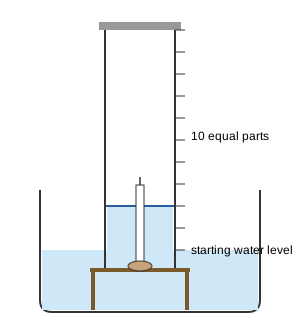
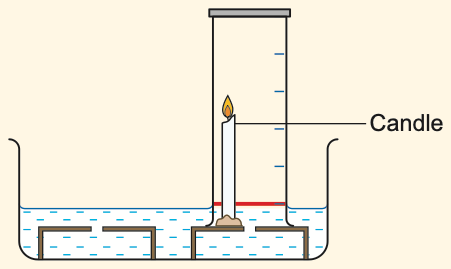
Diagram 1 shows a gas jar placed over a burning candle in a basin of water. The gas jar is divided into 10 equal parts. After the flame goes out, the water level rises as shown. What is the percentage of oxygen in the air from this experiment?
Diagram 1
Show answerHide answer
D
The water rose 2 of the 10 parts to replace the oxygen used up. 2 ÷ 10 × 100 = 20%.
ApplyingMedium7.1Textbook p. 197
7
What are the three conditions needed for combustion?
Show answerHide answer
B
Combustion needs fuel, oxygen and heat (the fire triangle). It produces heat and light.
RememberingLow7.2Textbook p. 204
8
Luqman uses a fire blanket to put out a small fire. How does the fire blanket work?
Show answerHide answer
C
A fire blanket is made of fire-resistant material. It covers the fire and stops oxygen from seeping underneath, so the fire goes out (the covering method).
ApplyingMedium7.2Textbook p. 207
9
Some sodium metal catches fire in a laboratory. Which is the most suitable way to put out the fire?
Show answerHide answer
A
Metal fires (potassium, sodium, magnesium, calcium) are put out with dry powder or dry sand. Water must not be used on these reactive metals.
ApplyingMedium7.2Textbook p. 206
10
Which air pollutant causes the thinning of the ozone layer?
Show answerHide answer
D
CFCs from air-conditioners, refrigerators and aerosol sprays thin the ozone layer. Carbon dioxide adds to the greenhouse effect; sulphur dioxide causes acid rain.
RememberingLow7.3Textbook p. 210
11
Which source releases radioactive materials into the air?
Show answerHide answer
C
Nuclear power plants are the source of radioactive pollutants. Quarries release dust; refrigerators release CFC; vehicles release smoke and carbon monoxide.
RememberingLow7.3Textbook p. 209
12
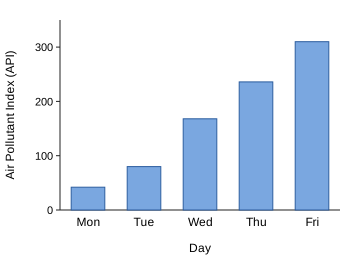
Diagram 2 shows the Air Pollutant Index (API) in a town over five days. On which day was the air quality at the unhealthy level (API 101–200)?
Diagram 2
Show answerHide answer
B
Wednesday's API is between 100 and 200 (unhealthy). Tuesday is below 100 (moderate), Thursday is between 200 and 300 (very unhealthy) and Friday is above 300 (hazardous).
AnalysingMedium7.3Textbook p. 195
Section B: structured questions
32 marks
Answer all questions. Write your answers in the spaces provided.
13
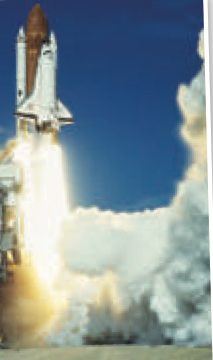
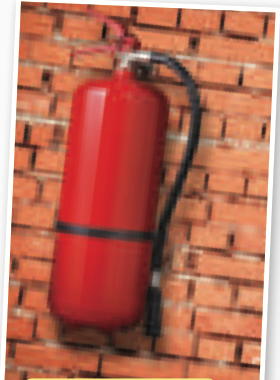
Diagram 3 shows four uses of gases in the air, P, Q, R and S. Choose the gas used in each.
[1 mark](a)P: a rocket engine burning fuel at high altitudesPShow answerHide answer
Oxygen
Oxygen is needed to burn the rocket fuel at high altitudes.
[1 mark](b)Q: a fire extinguisherQShow answerHide answer
Carbon dioxide
Carbon dioxide is used in fire extinguishers.
[1 mark](c)R: fertiliser being spread on a padi fieldRShow answerHide answer
Nitrogen
Nitrogen is used to make ammonia for nitrogen fertilisers.
[1 mark](d)S: a light bulbSShow answerHide answer
Argon
Argon, an inert gas, fills light bulbs.
RememberingLow7.1Textbook p. 199
14
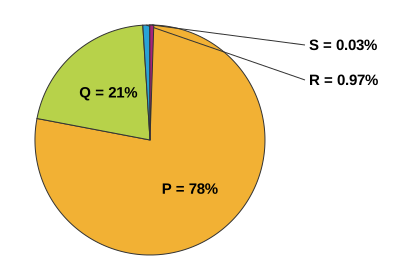
Diagram 4 shows the percentage of gases P, Q, R and S in the air.
Diagram 4
[1 mark](a)Name gas P.Show answerHide answer
Nitrogen
P = 78% = nitrogen.
[1 mark](b)Name gas S.Show answerHide answer
Carbon dioxide
S = 0.03% = carbon dioxide.
[1 mark](c)State one importance of gas Q.
Show answerHide answer
Any 1 points
Respiration (by living things)1
Combustion / burning of fuel1
Welding and cutting steel1
Q = 21% = oxygen.
Tick each point you got.
[2 marks](d)What would happen to the temperature of the Earth if the percentage of gas S increases? Give a reason.
Show answerHide answer
The temperature of the Earth increases / global warming1
Gas S (carbon dioxide) traps heat / causes the greenhouse effect1
Tick each point you got.
UnderstandingMedium7.1Textbook p. 214
15
Aina carried out Activity 7.1. She lit a candle and covered it with a gas jar standing in a basin of water, as in Diagram 5. The gas jar held 500 cm³ of air at the start. When the flame went out, 395 cm³ of gas was left in the jar.
Diagram 5
[1 mark](a)Why did the candle flame go out after a while?
Show answerHide answer
All the oxygen in the gas jar was used up (by the burning candle)1
Tick each point you got.
[1 mark](b)Explain why the water level in the gas jar rose.
Show answerHide answer
Water rose to take the place of the oxygen that was used up1
Tick each point you got.
[2 marks](c)Calculate the percentage of oxygen in the air from Aina's results.
Show answerHide answer
Oxygen used = 500 − 395 = 105 cm³1
Percentage = 105 ÷ 500 × 100 = 21%1
Tick each point you got.
ApplyingMedium7.1Textbook p. 197
16
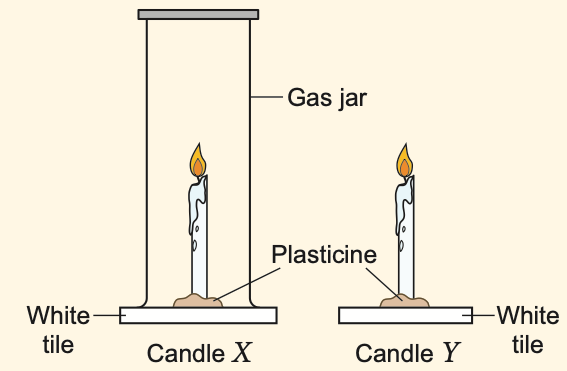
Diagram 6 shows two candles of the same size. Candle X is covered with a gas jar. Candle Y is not covered.
Diagram 6
[1 mark](a)Which candle goes out first?Show answerHide answer
Candle X
X has only the oxygen inside the gas jar.
[1 mark](b)Explain your answer to (a).
Show answerHide answer
The oxygen in the gas jar is used up / candle Y keeps getting oxygen from the surrounding air1
Tick each point you got.
[1 mark](c)State the conclusion of this activity.
Show answerHide answer
Oxygen is needed for combustion1
Tick each point you got.
AnalysingMedium7.2Textbook p. 205
17
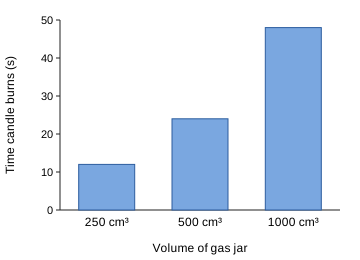
Hakim placed three gas jars of different volumes over three identical burning candles and recorded how long each candle kept burning. Diagram 7 shows his results.
Diagram 7
[1 mark](a)State the manipulated variable.
Show answerHide answer
Volume of the gas jar1
Tick each point you got.
[1 mark](b)State the responding variable.
Show answerHide answer
Time the candle keeps burning1
Tick each point you got.
[1 mark](c)State the relationship between the volume of the gas jar and the time the candle burns.
Show answerHide answer
The larger the volume of the gas jar, the longer the candle burns (because there is more oxygen)1
Tick each point you got.
[1 mark](d)Predict how long a candle would burn under a 750 cm³ gas jar.
Show answerHide answer
36 s (accept 34–38 s)1
750 cm³ is halfway between 500 cm³ (24 s) and 1000 cm³ (48 s): (24 + 48) ÷ 2 = 36 s.
Tick each point you got.
AnalysingHigh7.2Textbook p. 205
18
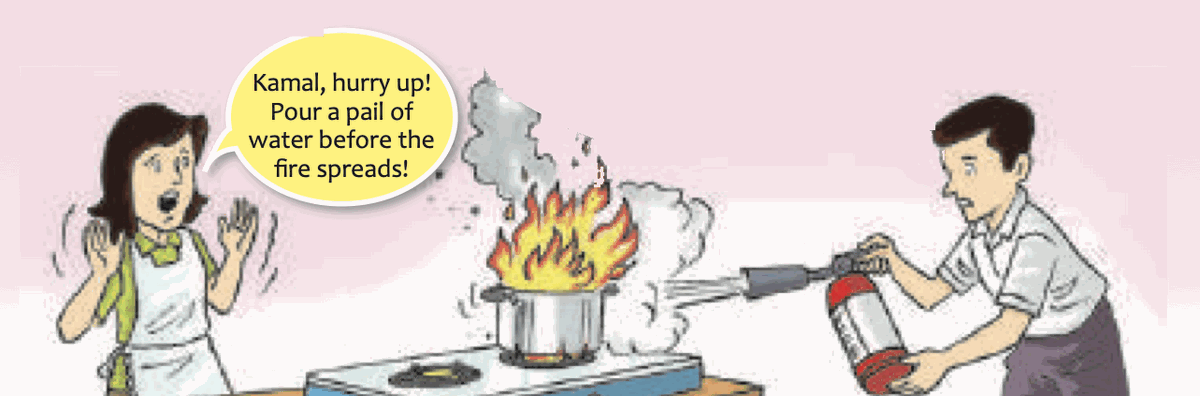
Diagram 8 shows a pot of cooking oil that has caught fire in a kitchen. The woman tells Kamal to pour a pail of water on it.
Diagram 8
[2 marks](a)Is the woman's advice correct? Give a reason for your answer.
Show answerHide answer
No / not correct1
Water is denser than oil, so it sinks below the oil and the oil keeps burning (the fire may splash and spread)1
Tick each point you got.
[1 mark](b)Name one type of fire extinguisher that is suitable for this fire.
Show answerHide answer
Foam / dry powder / carbon dioxide1
Liquid fires (oil, varnish, paint) are put out with foam, dry powder or carbon dioxide (Table 7.1).
Tick each point you got.
[1 mark](c)Explain how a foam extinguisher puts out the fire.
Show answerHide answer
Foam covers the surface of the oil and cuts off the oxygen (air) supply1
Tick each point you got.
EvaluatingHigh7.2Textbook p. 206
19
A large area of forest near your town has been cleared for logging. Scientists found that the amount of carbon dioxide in the air in the area has increased.
[2 marks](a)Explain how logging increases the amount of carbon dioxide in the air.
Show answerHide answer
Any 2 points
Fewer trees / green plants carry out photosynthesis1
So less carbon dioxide is absorbed, while respiration, decomposition and combustion continue to release it1
Burning the cleared forest also releases carbon dioxide1
Tick each point you got.
[2 marks](b)Your school wants to help keep the carbon dioxide and oxygen in the air balanced. Plan two actions your school can take, and explain how each one helps.
Show answerHide answer
Any two actions, each with a matching reason (1 mark each).
Any 2 points
Plant trees / start a tree-planting (reforestation) or school garden project — more photosynthesis absorbs carbon dioxide and releases oxygen1
Ban open burning of rubbish / compost or recycle instead — less carbon dioxide and smoke released1
Encourage walking, cycling, car pooling or public transport to school — less smoke and carbon dioxide from vehicles1
Run an awareness campaign / poster on the carbon and oxygen cycles — more people reduce harmful activities1
Tick each point you got.
CreatingHigh7.1Textbook p. 203
20
Choose the main effect of each pollutant on the environment.