Light and Optics
By the end of this chapter you can
- Tell real and virtual images apart, describe the images formed by plane, concave and convex mirrors, and explain how mirrors and optical instruments are used (8.1)
- Describe the properties of light — it travels very fast and in straight lines, forming shadows (8.2)
- State the characteristics of the image in a plane mirror and use the Law of Reflection to draw ray diagrams (8.3)
- Explain refraction when light moves between media of different densities, draw ray diagrams and give daily-life examples (8.4)
- Explain how white light is dispersed into a spectrum and how a rainbow forms (8.5)
- Explain scattering of light and why the sky is blue at midday and reddish at sunset (8.6)
- Identify primary and secondary colours, and explain addition and subtraction of light, including colour filters (8.7)
8.1The Use of Mirrors
Real image and virtual image
A virtual image is an image that cannot be formed on a screen.
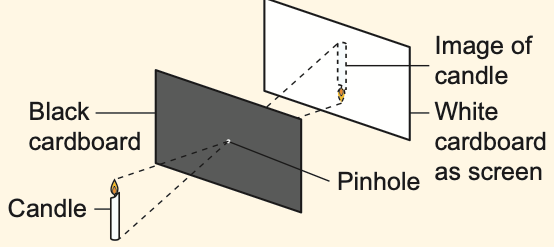
In Activity 8.1, light from a candle passes through a tiny pinhole in black cardboard and makes an image of the candle on a white cardboard screen. Because the image appears on a screen, it is a real image. When you look into a mirror, your image seems to be behind the mirror. You cannot catch it on a screen, so the image in a plane mirror is a virtual image.
Three types of mirrors
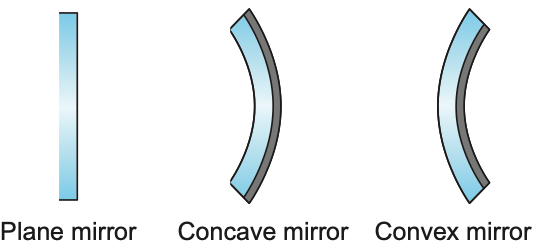
| Mirror | Shape of shiny surface | Image of a nearby object | Uses |
|---|---|---|---|
| Plane mirror | Flat | Same size, upright, virtual; image distance = object distance | Dressing mirror, dance studio, making a room look spacious, lifts, periscope, kaleidoscope |
| Concave mirror | Curves inwards (like a cave) | Bigger (magnified), upright, virtual | Make-up mirror, dentist's mirror |
| Convex mirror | Bulges outwards | Smaller, upright, virtual; gives a wide view | Dangerous road corners, supermarkets (to prevent theft), bicycle and vehicle side mirrors |
 Plane mirror
Helps a dancer correct his movements
 Concave mirror
Dentist sees teeth bigger and closer
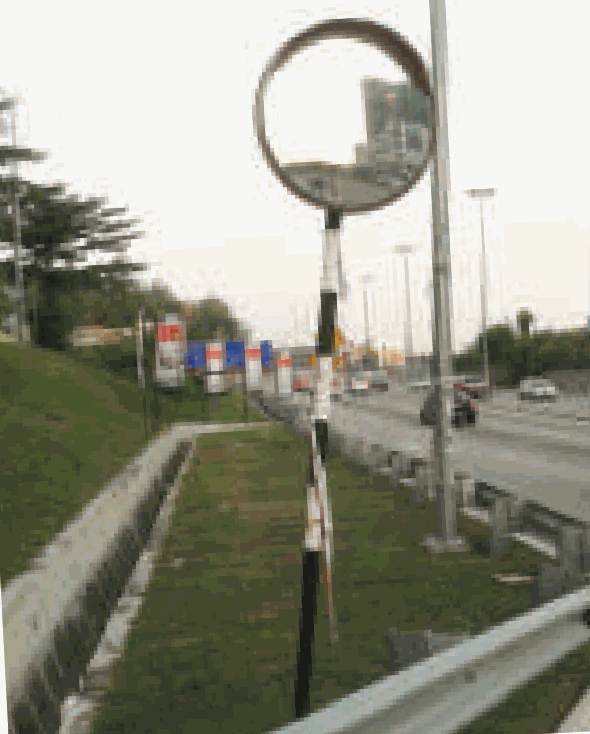 Convex mirror
Safety at a dangerous road corner
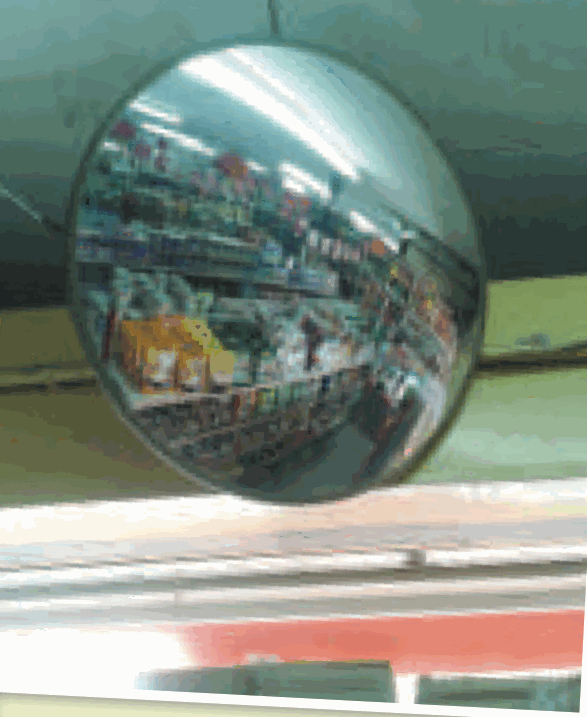 Convex mirror
Shopkeeper sees every corner of the shop
Photographs: Science Form 1 (DLP) textbook, Photograph 8.2, pp. 224–225.
Light reflects off a mirror
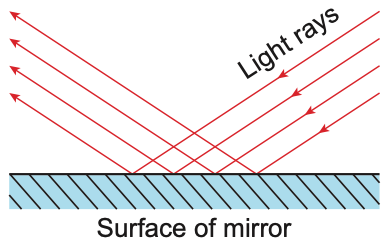
A plane mirror works by reflection of light: light rays that shine on the mirror bounce off it. Every image you see in a mirror is made by reflected light.
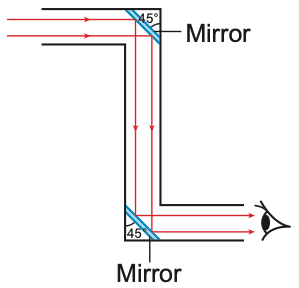
Optical instruments that use reflection
Scientists invented optical instruments to extend the ability of our senses, for example to see things that are hidden from view.
A path with a blind corner? Fix a convex mirror at the corner so people can see what is coming.
Cycling? A convex mirror on the bicycle lets you see the road behind you.
Show answerHide answer
8.2Properties of Light
Light travels in straight lines.
- Lightning before thunder. Lightning and thunder happen at the same time, but light travels much faster than sound, so we see the lightning before we hear the thunder.
- Shadows. Light travels in straight lines and cannot bend around an opaque object (an object light cannot pass through). The dark area behind the object, where light is blocked, is a shadow.
- Rainbows. Light can also be dispersed (split up) by water droplets in the sky to form a rainbow (see 8.5).
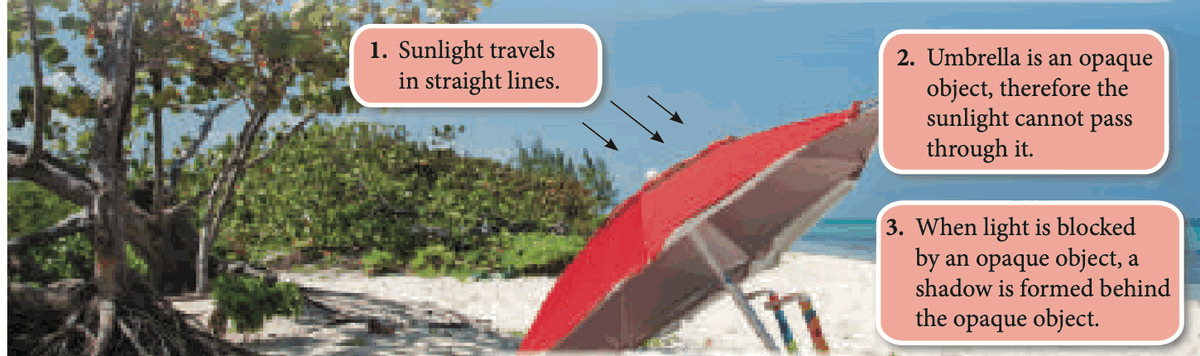
Your shadow is shortest at noon, when the Sun is directly above your head, and long in the morning and evening, when the Sun is low. The ancient sundial used the moving shadow of a stick to tell the time, and shadow puppets (wayang kulit) also use shadows made by blocking light.
Show answerHide answer
8.3Reflection of Light
Image formed by a plane mirror
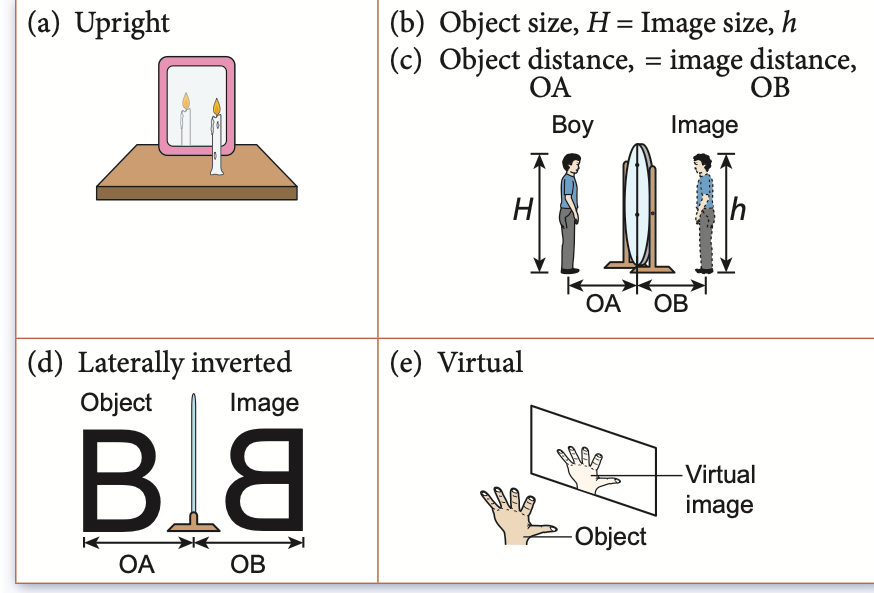
Image distance = object distance = 2 m behind the mirror.
Distance between Mei and her image = 2 + 2 = 4 m.
The word "AMBULANCE" is painted laterally inverted on the front of an ambulance. When drivers in front look in their rear-view mirror, the mirror inverts it again, so they read it the right way round.
The Law of Reflection
The normal is an imaginary line drawn at 90° to the mirror where the ray hits it. Angles are always measured from the normal, not from the mirror.
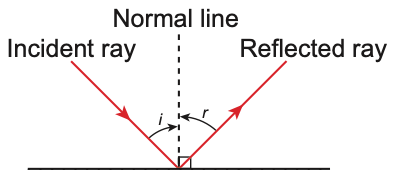
1. The incident ray, the reflected ray and the normal all lie on the same plane.
2. The angle of incidence, i is equal to the angle of reflection, r (i = r).
Responding variable: angle of reflection, r. Constant variable: size of the slit.
Result: r is always equal to i — the hypothesis is accepted.
Uses of reflection: road signs, traffic cones and warning triangles have reflective surfaces that reflect car headlights back so drivers can see them at night.
Show answerHide answer
8.4Refraction of Light
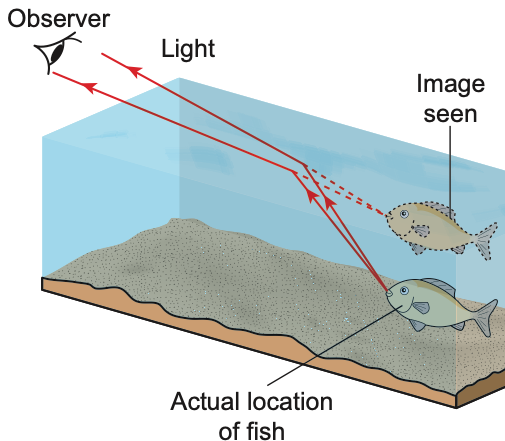
Refraction explains why a deep pond looks shallower than it really is, why a fish looks closer to the surface than it is, and why a pencil or spoon looks bent in a glass of water.
Ray diagrams for refraction
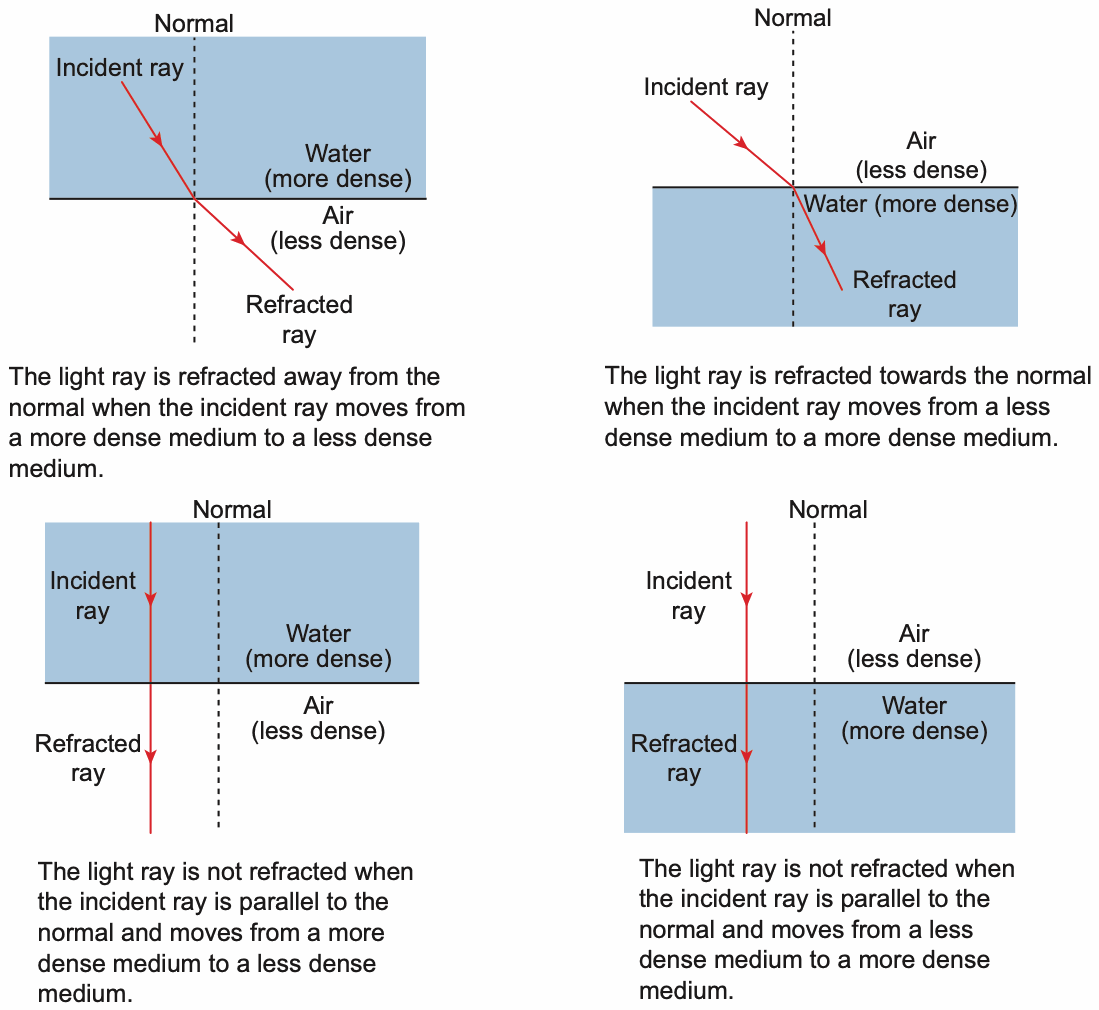
| Light travels from … | What happens | Angle |
|---|---|---|
| Less dense → more dense (air → water, air → glass) | Bends towards the normal | r smaller than i |
| More dense → less dense (water → air, glass → air) | Bends away from the normal | r bigger than i |
| Along the normal (at 90° to the surface) | Not refracted — goes straight through | i = 0° |
Result: the greater the angle of incidence, the greater the angle of refraction — but r is always smaller than i, because the ray bends towards the normal in glass.
Catching fish: because the fish is really deeper than it looks, a fisherman with a spear must aim below the image he sees.
Show answerHide answer
8.5Dispersion of Light
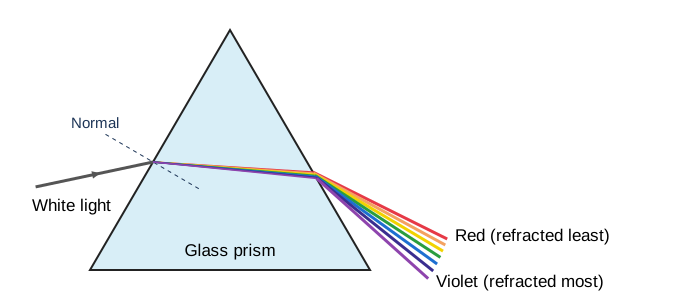
- When white light enters the prism, each colour bends towards the normal by a different amount.
- When the colours leave the prism, they bend away from the normal and spread out further, forming a spectrum.
Each colour travels at a different speed in glass. Red light is the fastest, so it is refracted the least. Violet light is the slowest, so it is refracted the most.
Rainbow: when sunlight enters raindrops in the sky, the white light is refracted and dispersed into seven colours, forming a rainbow. You can also see a rainbow at a fountain or a waterfall, or make one with a mirror in a basin of water and a torch (Activity 8.7).
Show answerHide answer
8.6Scattering of Light
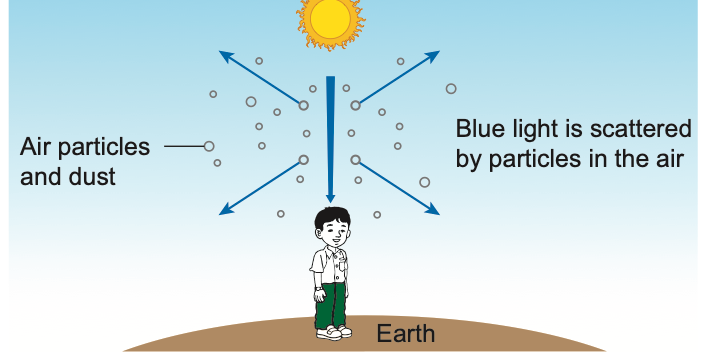 Midday: blue skyThe Sun is overhead. Blue light is scattered the most in all directions by the tiny particles, so blue light reaches our eyes from every part of the sky. The sky looks blue.
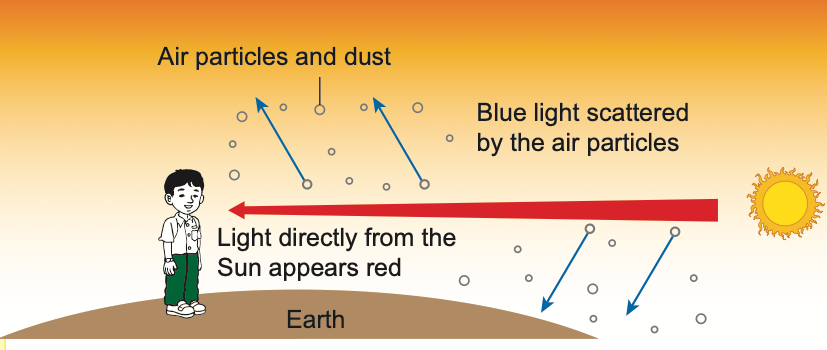 Sunset: reddish skyThe Sun is at the horizon, so its light passes through much more atmosphere. Blue light is scattered away; red and orange light are scattered less and reach our eyes. The sky looks reddish.
Diagrams: Science Form 1 (DLP) textbook, Figures 8.21 and 8.22, pp. 239–240.
In Activity 8.8, milk powder stirred into water acts like the particles in the air. From the side, the beam looks bluish (blue light is scattered sideways); the light reaching the screen looks orange-red (the blue has been scattered out).
Show answerHide answer
8.7Addition and Subtraction of Light
Secondary colours: yellow, magenta, cyan — made by mixing two primary colours.
Addition of light
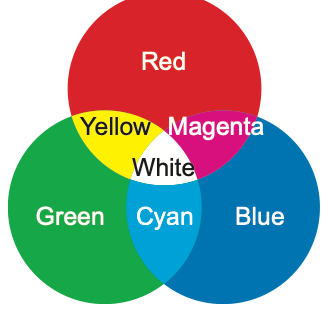
| Primary colour | + Primary colour | = Secondary colour |
|---|---|---|
| Red | Blue | Magenta |
| Red | Green | Yellow |
| Blue | Green | Cyan |
| Red + Green + Blue = White | ||
Subtraction of light
| Object (in white light) | Reflects | Absorbs |
|---|---|---|
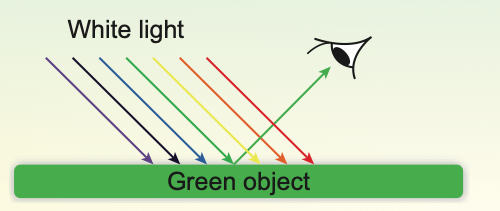
| Primary colour, e.g. green | Green only | All other colours |
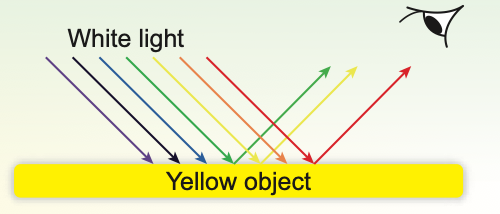
| Secondary colour, e.g. yellow | Yellow, plus red and green (the primaries that make yellow) | Other colours |
| White | All colours | None |
| Black | None | All colours |
Colour filters
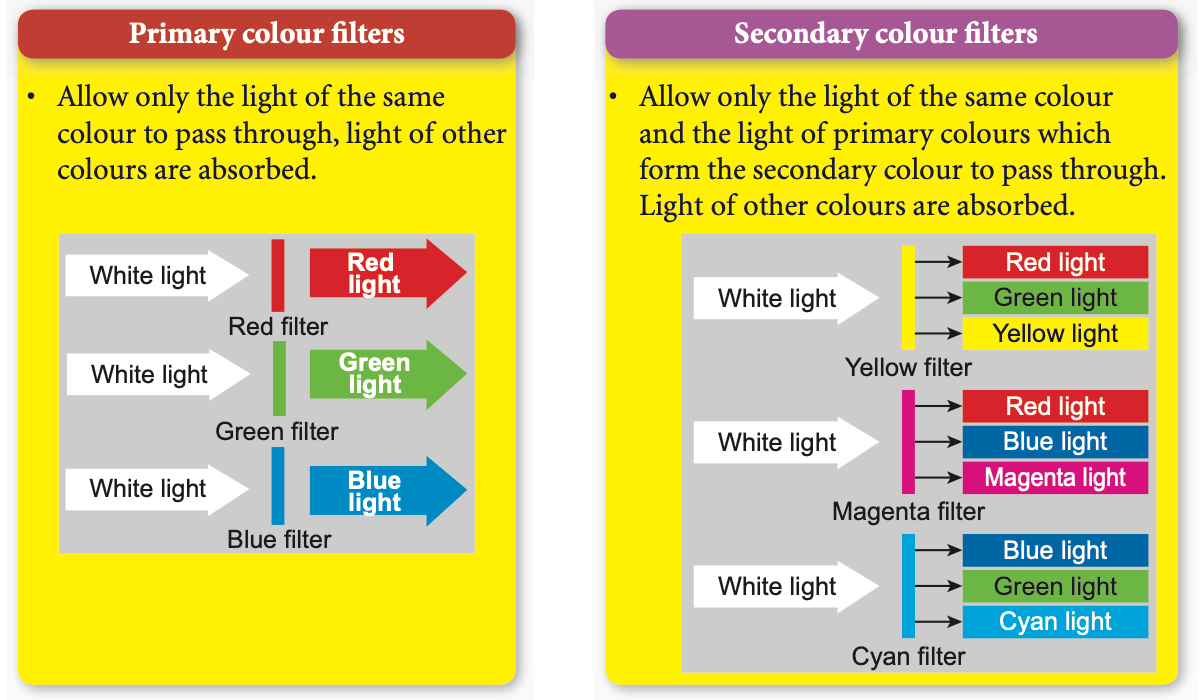
- A primary colour filter lets only light of its own colour pass through. A red filter lets only red light through.
- A secondary colour filter lets through its own colour and the two primary colours that make it. A yellow filter lets through yellow, red and green light.
Colour on the screen: red.
White light → red filter → cyan filter (lets only green and blue through) → red is absorbed → screen is dark (black).
Subtraction = an object or filter absorbs some colours and reflects or lets through the rest.
In daily life: colour televisions, coloured stage lights, stadium lights and the coloured lights in the fountain in front of KLCC all mix red, green and blue light to make many colours.
Show answerHide answer
Summary
| Remember | Key fact |
|---|---|
| Real vs virtual image | Real can be formed on a screen; virtual cannot |
| Mirrors | Plane: same size; concave: bigger (make-up, dentist); convex: smaller, wide view (road corners, shops) |
| Properties of light | Very fast (3.0 × 10⁸ m s−1); travels in straight lines → shadows |
| Plane mirror image | Upright, laterally inverted, same size, virtual, image distance = object distance |
| Law of Reflection | i = r; measured from the normal |
| Refraction | Less dense → more dense: towards normal; more dense → less dense: away from normal |
| Dispersion | White light → spectrum ROYGBIV; red refracted least, violet most; rainbow |
| Scattering | Blue scattered most → blue sky at midday; red scattered least → reddish sunset |
| Addition of light | R + G = yellow; R + B = magenta; B + G = cyan; R + G + B = white |
| Subtraction of light | Objects and filters absorb some colours; white reflects all, black absorbs all |