Air
By the end of this chapter you can
- State the composition of air, explain why air is a mixture, give the uses of oxygen, nitrogen, carbon dioxide and inert gases, and describe how the carbon and oxygen cycles keep the gases in balance (7.1)
- State the three conditions needed for combustion, relate them to how fire extinguishers work, and practise fire safety (7.2)
- Define air pollution and air pollutants, name their sources and effects, and justify ways to prevent and control air pollution (7.3)
7.1Composition of Air
All living things need air to survive. Clean air has no colour and no smell, so we cannot see it, even though it contains many substances. You learned in Chapter 5 that air has mass and occupies space.
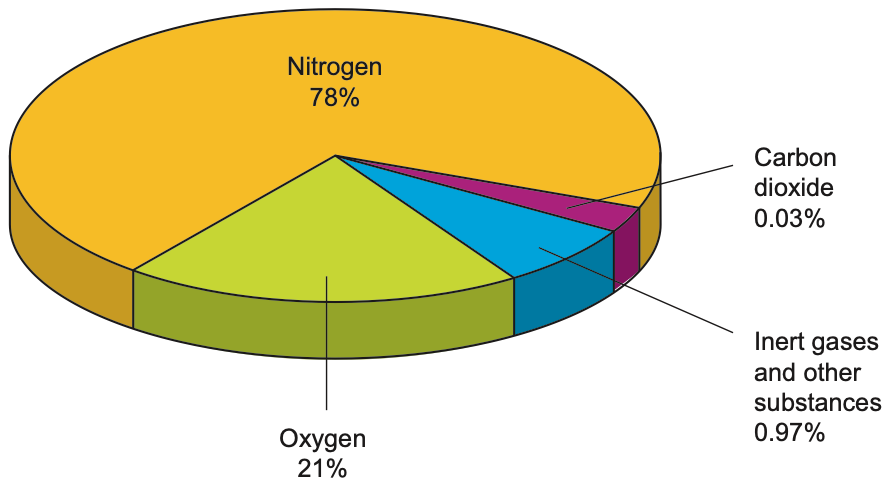
Air also contains small amounts of water vapour, dust and microorganisms. Their amounts change with place and time. For example, there is more water vapour in a forest or after rain than on a hot, dry day. Some illnesses, such as fever, are caused by microorganisms carried in the air.
Finding the percentage of oxygen in air (Activity 7.1)
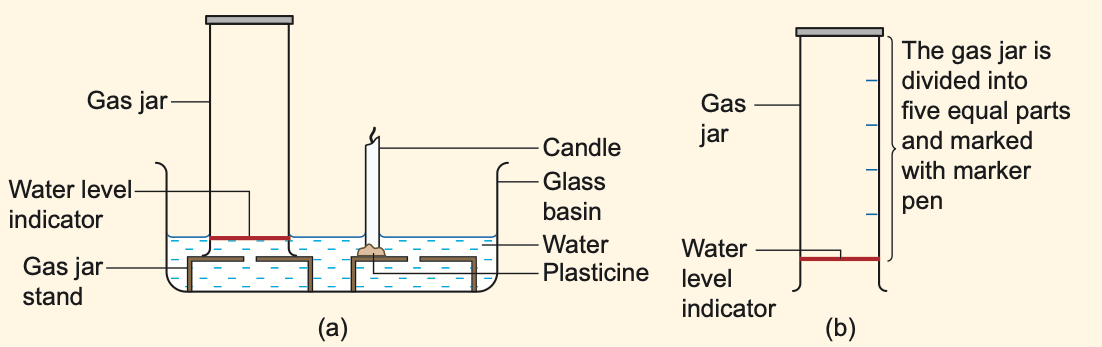
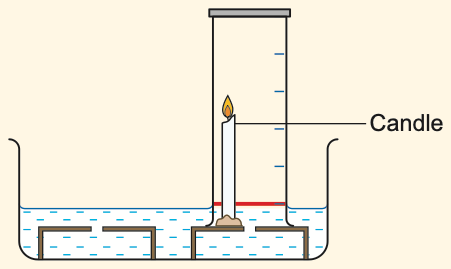
- A lit candle is covered with the gas jar.
- The candle uses up the oxygen inside the jar as it burns.
- When the oxygen is used up, the flame goes out.
- Water rises into the jar to take the place of the oxygen used up.
- The water rises by about one fifth of the jar, so air contains about 20% oxygen.
Oxygen used = 500 − 400 = 100 cm3. Percentage of oxygen = 100 ÷ 500 × 100 = 20%.
Is air a mixture or a compound?
The importance of gases
| Gas | Uses |
|---|---|
| Oxygen | Respiration; burning fuel in rocket engines at high altitudes; welding and cutting steel; making many compounds |
| Carbon dioxide | Photosynthesis; making fizzy (carbonated) drinks; fire extinguishers; part of the carbon cycle |
| Nitrogen | Making nitric acid and ammonia (for nitrogen fertilisers); part of the nitrogen cycle; liquid nitrogen as a cooling agent |
| Inert gases | Helium fills hot-air balloons and weather balloons; neon is used in advertising lights; argon fills light bulbs |
Uses of gases: textbook Figure 7.5, p. 199.
Show answerHide answer
The carbon cycle
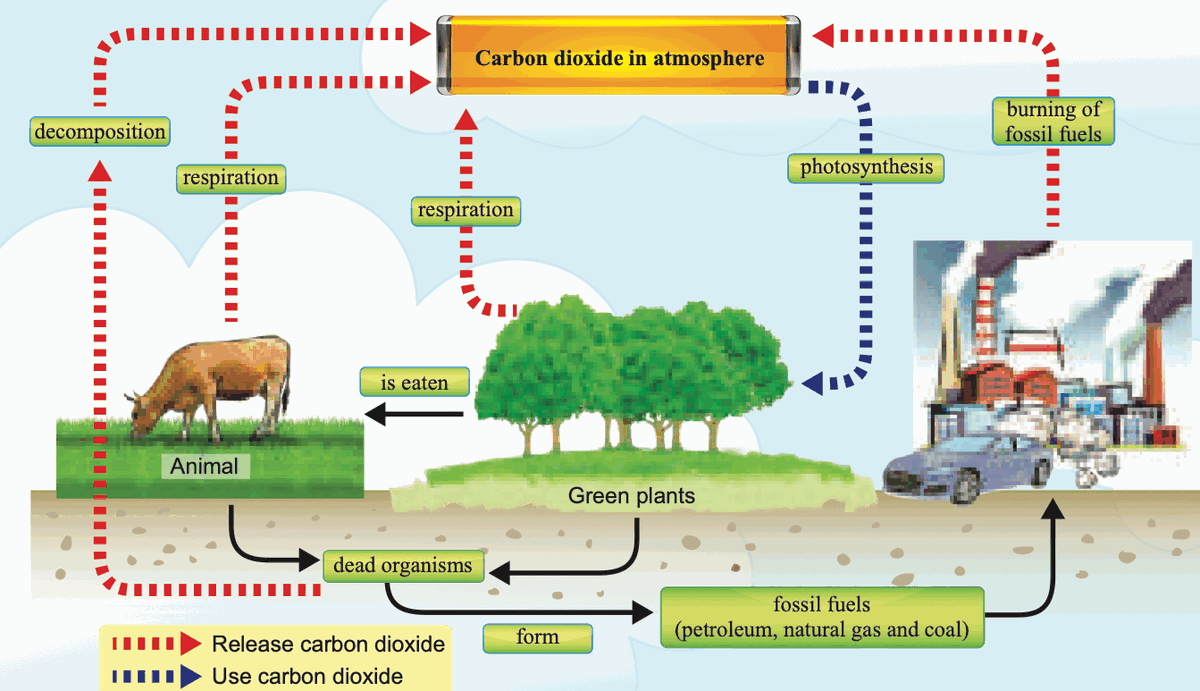
- Green plants take in carbon dioxide during photosynthesis.
- Animals get carbon by eating plants.
- Plants and animals release carbon dioxide during respiration.
- When they die, bacteria and fungi decompose them and release carbon dioxide.
- Dead organisms buried for a very long time form fossil fuels (petroleum, natural gas, coal). Burning fossil fuels releases carbon dioxide.
- Respiration, decomposition and combustion (release) are balanced by photosynthesis (use).
The oxygen cycle
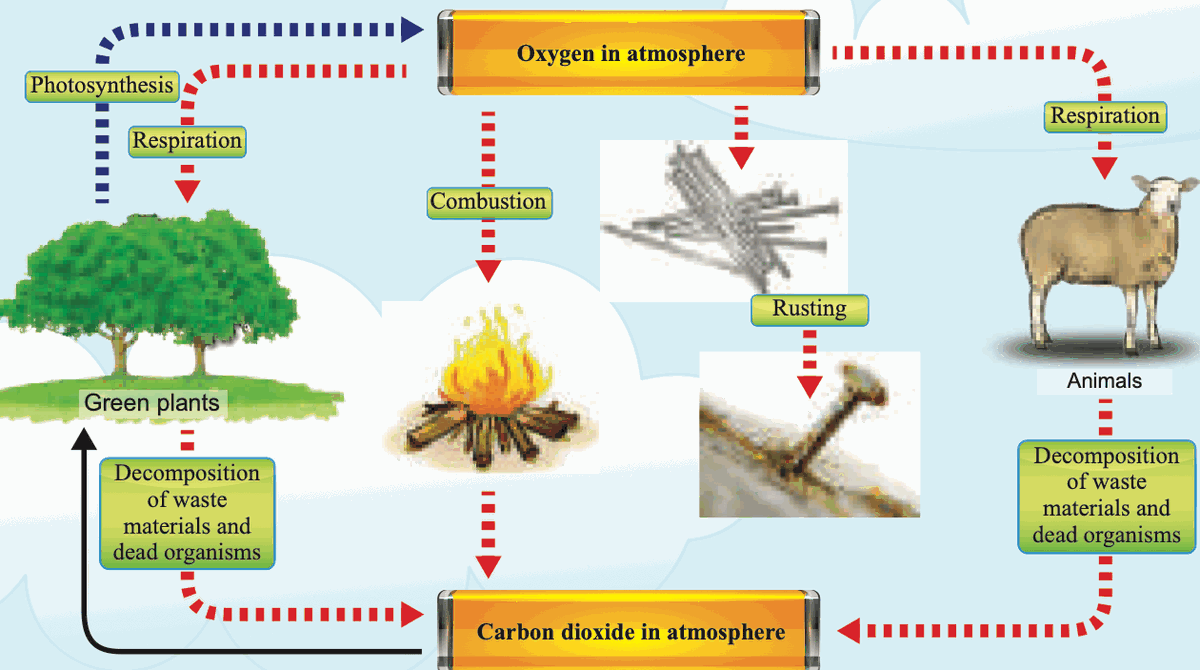
Interference to the cycles and how to prevent it
Human activities such as logging (cutting down trees), open burning and too much use of pesticides upset the cycles. Fewer plants means less carbon dioxide is taken in, so carbon dioxide builds up in the air. This leads to the greenhouse effect and global warming, and fertile land can become dry.
| Do not | Do |
|---|---|
| Log illegally | Reforestation — plant trees again |
| Burn forests | Prevent too much smoke from vehicles |
| Use too many pesticides | Reduce activities that harm the air |
Ways to reduce interference: textbook Photograph 7.4, p. 203.
Show answerHide answer
7.2Combustion
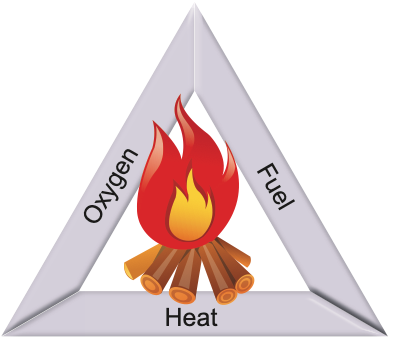
Combustion needs all three conditions:
- Fuel — something that can burn (wood, candle wax, paper, petrol)
- Oxygen — from the air
- Heat — enough to make the fuel start burning
Remove any one and the fire goes out. Blowing out a birthday candle works this way.
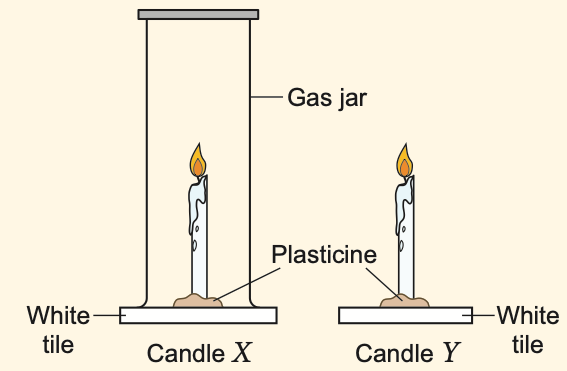
Proving the three conditions (Activity 7.3)
| Condition | What is done | Result and conclusion |
|---|---|---|
| Fuel | Hold a glass rod, wood, a candle and a stone in a Bunsen flame | Wood and candle burn (fuels); glass rod and stone do not (non-fuels). Fuel is needed. |
| Oxygen | Cover candle X with a gas jar; leave candle Y uncovered | Candle X goes out first because its oxygen is used up; Y keeps getting oxygen from the air. Oxygen is needed. |
| Heat | Strike match P (kept in a refrigerator) and match Q (room temperature) | The cold match P is harder to light. Heat is needed. |
Fire extinguishers
A fire extinguisher is a safety tool for putting out a small fire, usually in an emergency. The substance inside depends on what is burning.
| Material on fire | Examples | Suitable extinguisher |
|---|---|---|
| Solid | Wood, cloth, paper | Water, dry powder |
| Liquid | Oil, varnish, paint | Foam, dry powder, carbon dioxide |
| Gas | Propane, acetylene, methane | Foam, dry powder, carbon dioxide |
| Metal | Potassium, sodium, magnesium, calcium | Dry powder, dry sand |
Table 7.1, textbook p. 206.
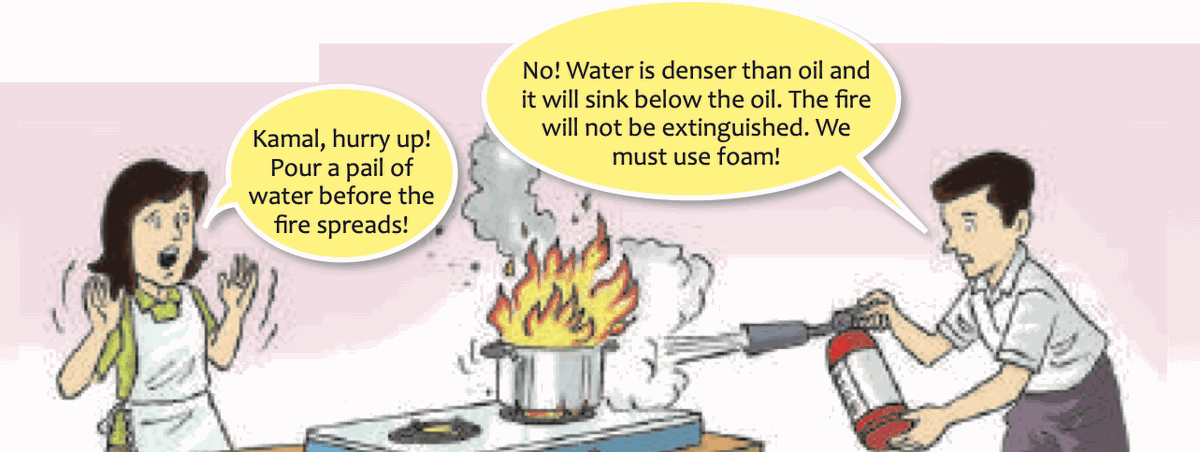
How fires are put out
Each method removes one of the three conditions:
| Method | What it does | Condition removed |
|---|---|---|
| Covering | Cuts off the fuel from air — fire blanket, wet sack, sand, soil, mud or foam | Oxygen |
| Cooling | Sprays water or carbon dioxide onto the burning material | Heat |
| Removing fuel | Separates burning materials, moves unburnt materials away, shuts off the gas or oil supply | Fuel |
Preventing fires
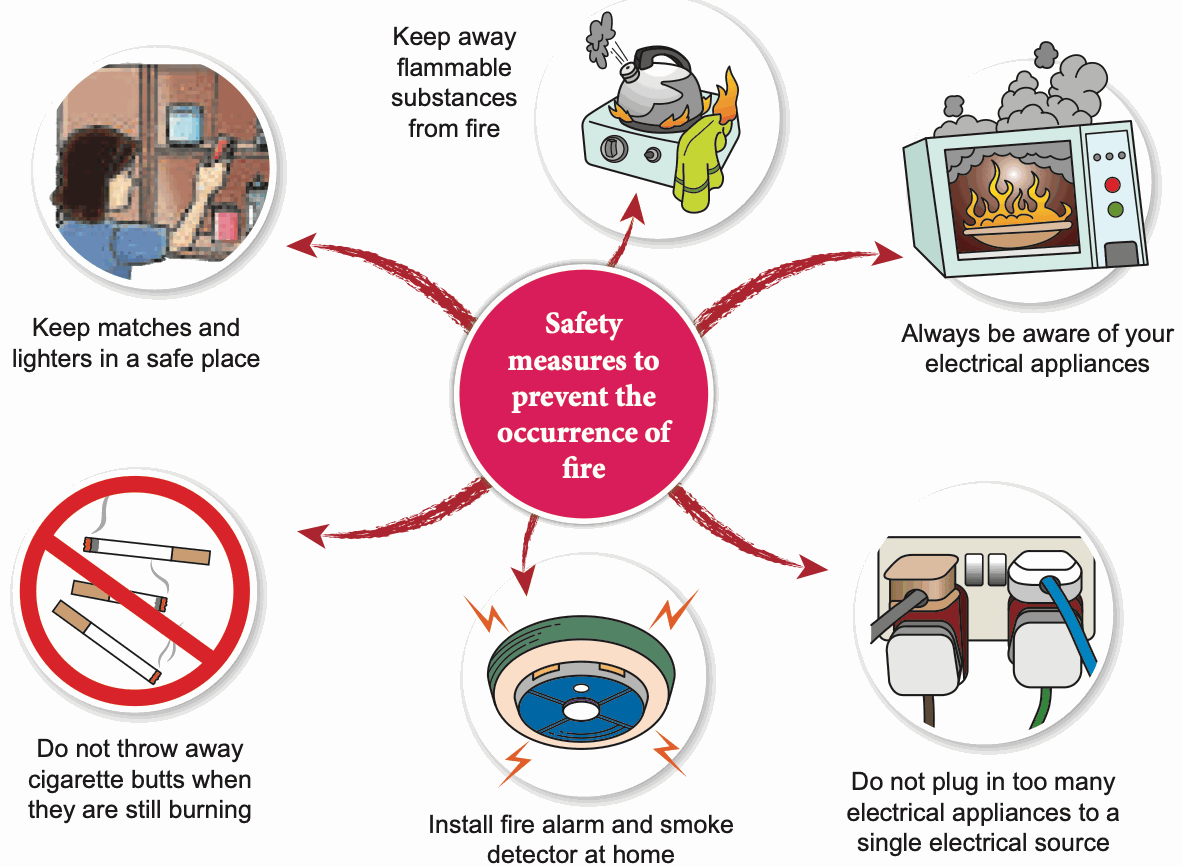
- Keep flammable substances away from fire; keep matches and lighters in a safe place.
- Always be aware of the electrical appliances you are using; do not plug too many appliances into one socket.
- Do not throw away cigarette butts that are still burning.
- Install a fire alarm and smoke detector at home.
Show answerHide answer
7.3Air Pollution
Sources of air pollutants
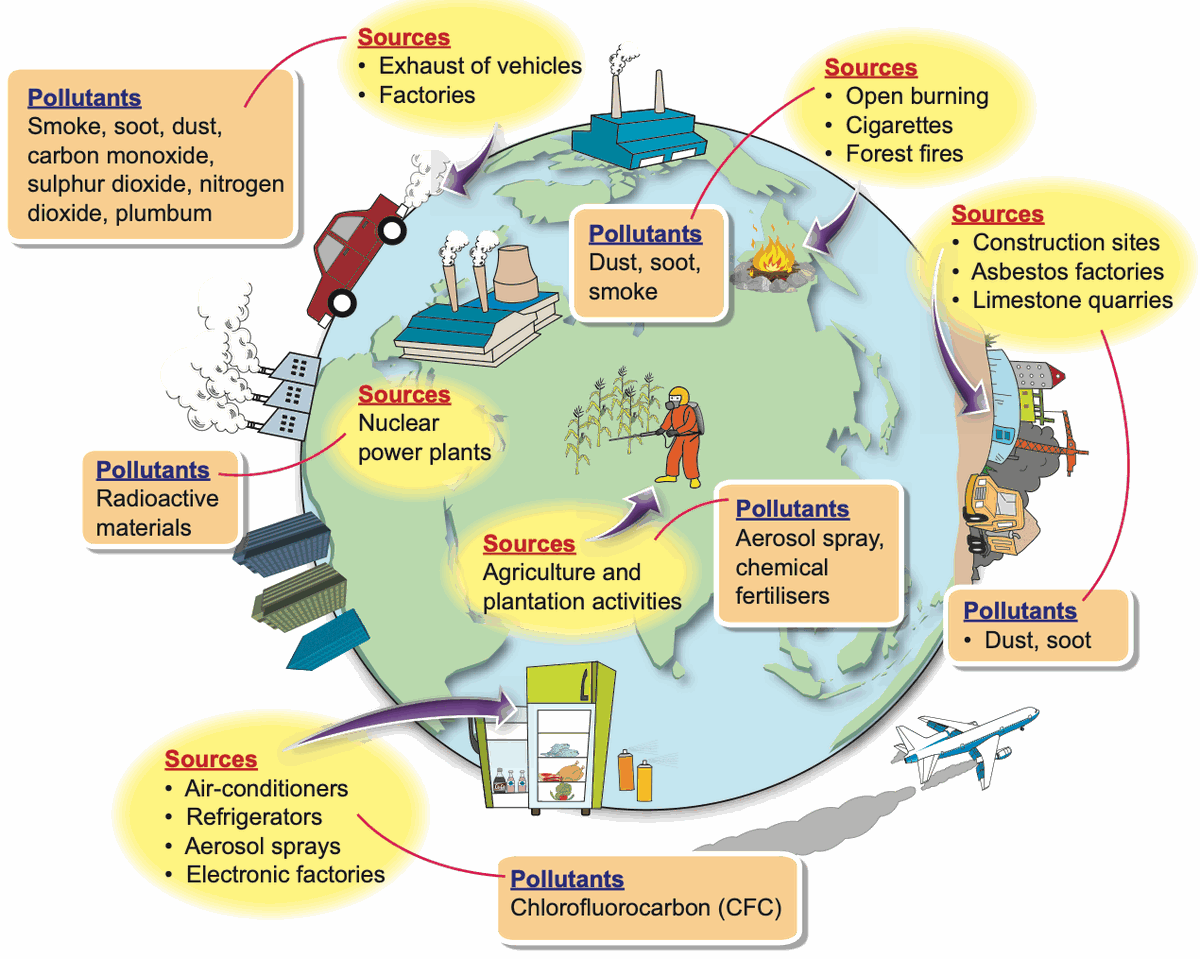
| Sources | Pollutants |
|---|---|
| Vehicle exhaust, factories | Smoke, soot, dust, carbon monoxide, sulphur dioxide, nitrogen dioxide, lead (plumbum) |
| Open burning, cigarettes, forest fires | Dust, soot, smoke |
| Construction sites, asbestos factories, limestone quarries | Dust, soot |
| Nuclear power plants | Radioactive materials |
| Agriculture and plantations | Aerosol spray, chemical fertilisers |
| Air-conditioners, refrigerators, aerosol sprays, electronic factories | Chlorofluorocarbons (CFC) |
The Air Pollutant Index (API)
Haze from open burning has affected Malaysia for many years. The Air Pollutant Index (API) tells us how polluted the air is and how it may affect our health.
| API | Level of pollution |
|---|---|
| 0 – 50 | Good |
| 51 – 100 | Moderate |
| 101 – 200 | Unhealthy |
| 201 – 300 | Very unhealthy |
| Above 300 | Hazardous |
Table 1, textbook p. 195.
Effects of air pollution
| Affects | Effects |
|---|---|
| Health | Smoke and dust cause breathing problems; sulphur dioxide causes respiratory problems; carbon monoxide causes headaches, mental retardation and death; asbestos particles cause lung cancer; lead particles cause intellectual disability in children and babies |
| Buildings | Dust and soot stain buildings; acid rain corrodes concrete and limestone and speeds up rusting of iron |
| Plants and animals | Acid rain makes soil acidic and less fertile, and makes water unsuitable for aquatic life; smoke and haze block sunlight and lower the rate of photosynthesis |
| Climate | Smoke causes haze; too much carbon dioxide adds to the greenhouse effect; CFCs thin the ozone layer; sulphur dioxide and nitrogen dioxide cause acid rain |
Figure 7.13 (a), textbook p. 210.
Preventing and controlling air pollution
| Approach | Examples |
|---|---|
| Law enforcement | Fine people who smoke in restricted areas, carry out open burning, or drive vehicles with too much smoke; do not allow factories in housing areas |
| Education | Teach the effects of air pollution; anti-smoking campaigns; encourage walking, cycling, public transport and car pooling |
| Science and technology | Hybrid vehicles; catalytic converters on vehicles; filters in factory chimneys; refrigerators using HCFC instead of CFC; biological control instead of pesticides |
Figure 7.13 (b), textbook p. 211.
Show answerHide answer
Summary
| Remember | Key fact |
|---|---|
| Composition of air | Nitrogen 78%, oxygen 21%, inert gases and others 0.97%, carbon dioxide 0.03% |
| Air is a mixture | Its gases are separated by a physical method (fractional distillation) |
| Inert gas uses | Helium — balloons; neon — advertising lights; argon — light bulbs |
| Carbon and oxygen cycles | Photosynthesis uses CO2 and releases O2; respiration, combustion, decomposition (and rusting) use O2 |
| Combustion | Needs fuel, oxygen and heat; produces heat and light |
| Putting out fire | Covering (oxygen), cooling (heat), removing fuel (fuel); oil fire → foam; metal fire → dry powder / dry sand |
| Air pollution | Pollutants in the air harm living things; CO2 → greenhouse effect, SO2/NO2 → acid rain, CFC → ozone thinning |
| API | 0–50 good, 51–100 moderate, 101–200 unhealthy, 201–300 very unhealthy, above 300 hazardous |