Periodic Table
By the end of this chapter you can
- Describe atoms, subatomic particles and molecules; tell elements from compounds; locate metals, non-metals and inert gases in the Periodic Table and compare metals with non-metals (6.1)
- Give examples of mixtures and choose a physical method to separate them — filtration, distillation, magnet, sedimentation, floatation, chromatography (6.2)
- Explain how compounds form, show that mass is conserved, separate compounds by electrolysis, and compare physical with chemical changes and mixtures with compounds (6.3)
6.1Classification of Elements
In Chapter 5 you learned that matter is anything that has mass and occupies space. All matter is made of tiny, separate particles called atoms. A metal bracelet is made of atoms packed tightly together; the hot air inside a hot air balloon is made of particles that are far apart.
To imagine how small an atom is: if an orange were an atom, the electron microscope would have to make it as big as the Earth for us to see it.
Inside an atom
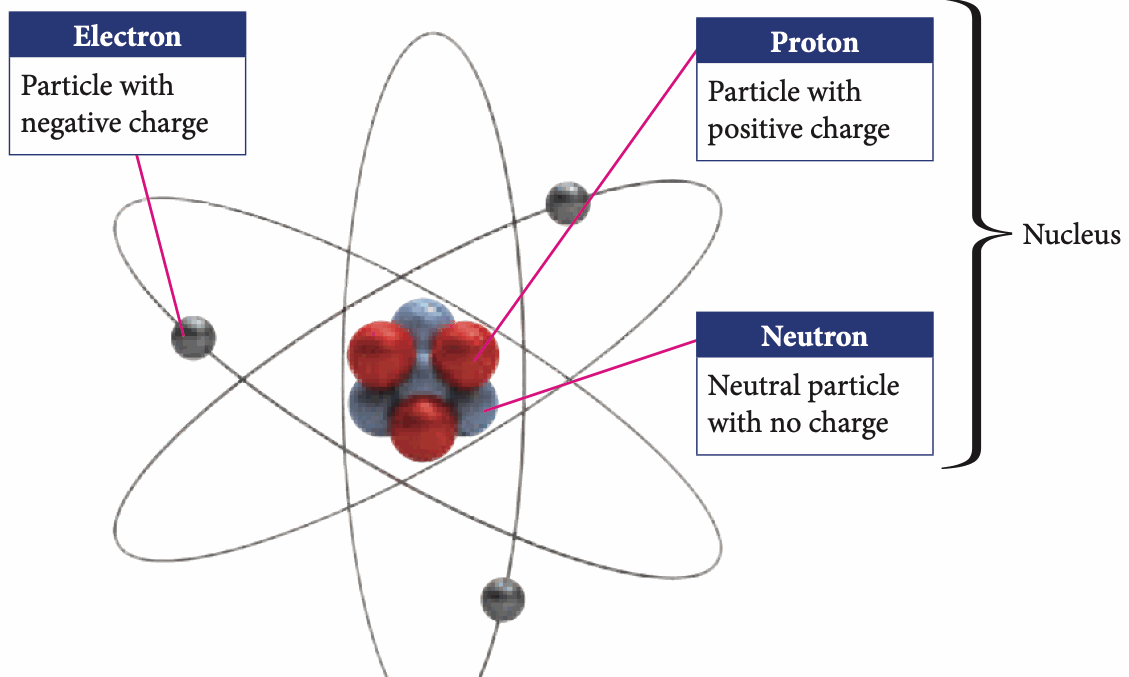
Textbook Figure 6.3, p. 165
| Subatomic particle | Charge | Where it is |
|---|---|---|
| Proton | Positive (+) | In the nucleus |
| Electron | Negative (−) | Moving around the nucleus |
| Neutron | No charge (neutral) | In the nucleus |
The nucleus has an overall positive charge because of its protons. An atom has the same number of electrons as protons, so the positive and negative charges cancel. That is why an atom is neutral.
Elements and compounds
Compound — two or more elements combined chemically. It is made by a chemical reaction.
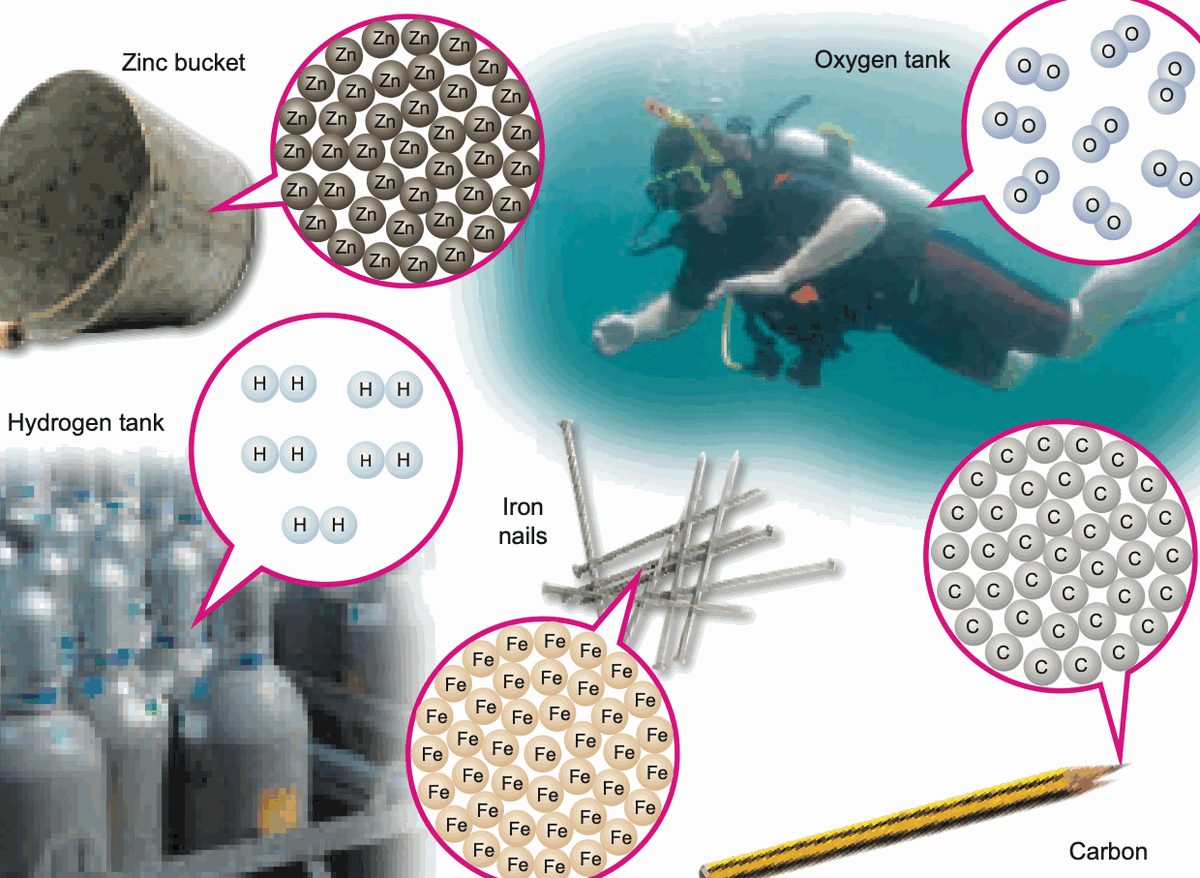
Textbook Figure 6.5, p. 166
| Examples | |
|---|---|
| Elements | Iron, oxygen, hydrogen, aluminium, carbon, copper (oxygen is the most abundant element on Earth) |
| Compounds | Salt (sodium + chlorine), sugar (carbon + hydrogen + oxygen), water (hydrogen + oxygen), shell (calcium + carbon + oxygen), aluminium oxide, zinc sulphide, iron chloride |
The parts of a compound cannot be separated by physical methods. They can only be separated chemically, for example by passing electricity through the compound (electrolysis).
Show answerHide answer
The Periodic Table
In the 18th and 19th centuries scientists discovered many elements. In 1869 the Russian chemist Dmitri Mendeleev arranged the 63 known elements in a table and left gaps for elements not yet found. When germanium was discovered in 1886 and matched his prediction, scientists accepted his idea. Today's Periodic Table arranges the elements in an orderly, systematic way according to proton number. As of 2016, 118 elements had been discovered.
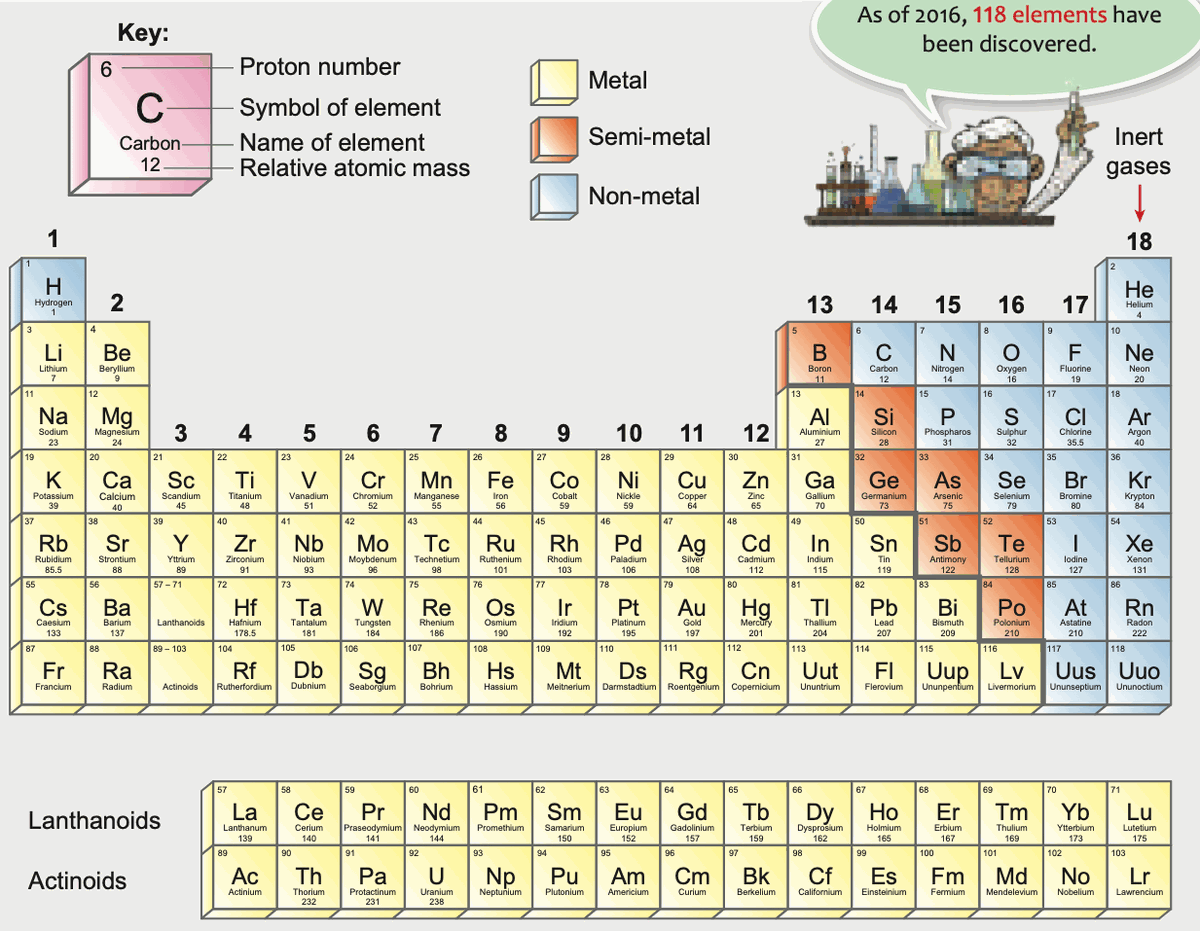
Textbook Figure 6.6, p. 167
| Type | Position in the Periodic Table | Examples |
|---|---|---|
| Metals | Left side and middle (the largest group) | Sodium, magnesium, aluminium, iron, copper, zinc, gold, mercury |
| Non-metals | Right side (and hydrogen at the top left) | Hydrogen, carbon, nitrogen, oxygen, sulphur, chlorine, iodine |
| Semi-metals | A "staircase" between metals and non-metals | Boron, silicon, germanium, arsenic |
| Inert gases | Last column on the right (Group 18) — they are non-metals | Helium, neon, argon, krypton, xenon |
How elements are named: some old names end in "-gen" (from "generator"): hydrogen means "water generator". New names must be approved by IUPAC (International Union of Pure and Applied Chemistry); many honour a scientist or a place, e.g. rutherfordium (Ernest Rutherford), bohrium (Niels Bohr), darmstadtium (Darmstadt, Germany).
Metals and non-metals
Both metals and non-metals are elements. They differ in their physical characteristics:
| Characteristic | Metals | Non-metals |
|---|---|---|
| Appearance | Shiny | Dull |
| Ductility (can be pulled / bent into wires) | Ductile | Brittle |
| Malleability (can be hammered into shape) | Malleable | Not malleable |
| Tensile strength | High | Low (break easily) |
| Electrical conductivity | Good | Poor (except carbon) |
| Heat conductivity | Good | Poor |
| Density | High | Low |
| Melting and boiling points | High | Low |
Based on textbook Figure 6.8, p. 169
Malleable, strong and light, grey and shiny — used for foil.
Strong, malleable, magnetic, good conductor — used for hoes.
Ductile, rustproof, good conductor, brown — used for electric wires.
Strong, grey, good conductor — used for roofs.
Black crystals, poisonous, antiseptic.
Greenish-yellow gas, poisonous, bleaching agent.
Yellow powder, poisonous — used to harden rubber tyres.
Black, smooth, light; the only non-metal that conducts electricity — pencil lead, racquets.
• Appearance: rub copper and carbon rods with sandpaper → copper is shiny, carbon is dull.
• Ductility: bend copper wire and pencil lead → copper wire bends into a circle; pencil lead snaps.
• Malleability: hammer iron, copper and sulphur → iron and copper flatten; sulphur shatters.
• Electrical conductivity: connect iron, carbon and sulphur rods in a circuit → the ammeter needle deflects for iron and carbon, not sulphur.
• Heat conductivity: heat one end of a rod with a thumbtack waxed to the other end → the thumbtack drops first on the best heat conductor (copper / iron), not on carbon.
• Melting point: heat tin and sulphur powder → sulphur melts first; tin (metal) has the higher melting point.
Some elements, such as germanium and silicon, have characteristics of both metals and non-metals. They are called semi-metals. Antoine Lavoisier was the first scientist to classify elements as metals and non-metals.
Show answerHide answer
6.2Mixtures
Because a mixture is made physically, it can be separated by physical methods. Which method to use depends on:
- the physical properties of the substances in the mixture (size, solubility, density, boiling point, magnetism), and
- the substance you want to obtain from the mixture.
| Method | Used to separate | Works because | Example |
|---|---|---|---|
| Filtration | An insoluble solid from a liquid | Solid particles are too big to pass through the filter paper | Sand and water; coffee powder from coffee |
| Distillation | Liquids that mix completely (miscible) | The liquids have different boiling points | Water and alcohol; making perfume from rose petals |
| Magnet | A magnetic solid from a non-magnetic solid | Iron, nickel and cobalt are attracted to a magnet | Iron nails and sand; iron and sulphur powder |
| Sedimentation | An insoluble solid from a liquid | The denser solid sinks and settles at the bottom | Sand / silt and water |
| Floatation | Substances that do not mix, by density | The less dense substance floats on top | Oil and water (separating funnel) |
| Chromatography | Small amounts of dissolved substances, e.g. dyes in ink | Different substances travel different distances up the paper | Colours in ink; harmful food colouring; drug tests on urine |
| Sieving | Small particles from larger ones | Particle size | Removing impurities from flour |
(a) Filtration
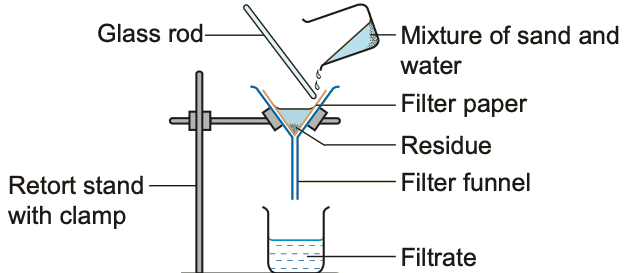
Textbook Figure 6.20, p. 178
(b) Distillation
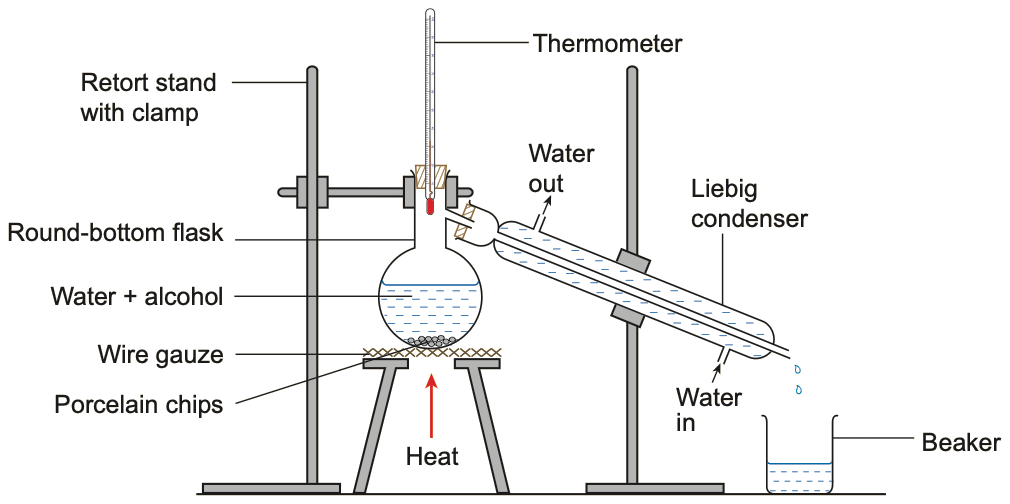
Textbook Figure 6.21, p. 179
- The thermometer bulb is at the side arm and measures the boiling point of the vapour leaving the flask.
- Cold water flows in at the bottom and out at the top of the Liebig condenser to cool the vapour back into a liquid.
- Porcelain chips make the boiling smooth (they stop the mixture from boiling up suddenly).
(c) Separation using a magnet
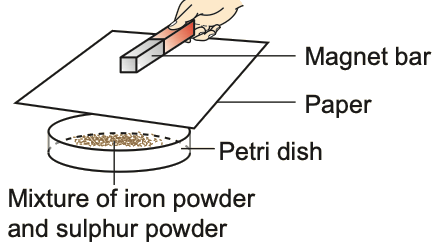
Textbook Figure 6.23, p. 181
- Magnetic metals: iron, nickel, cobalt. Non-magnetic metals: gold, bronze, aluminium.
- Food factories use magnet separators to remove iron particles; scrapyards use strong magnets to collect iron and steel.
(d) Sedimentation
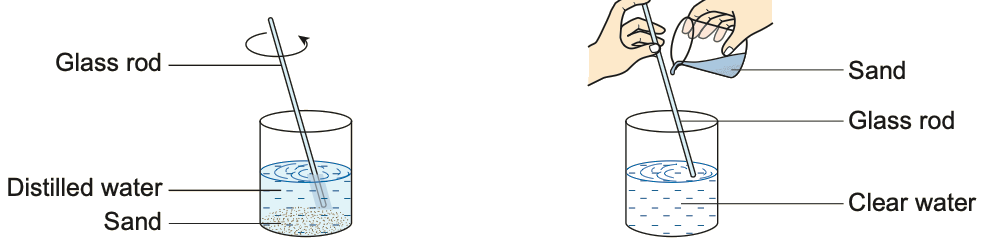
Textbook Figure 6.24, p. 182
(e) Floatation
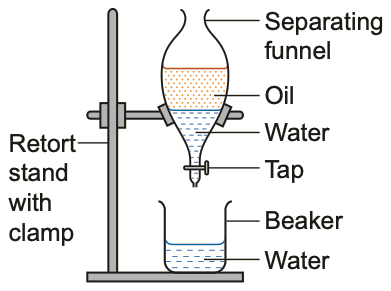
Textbook Figure 6.25, p. 183
(f) Chromatography
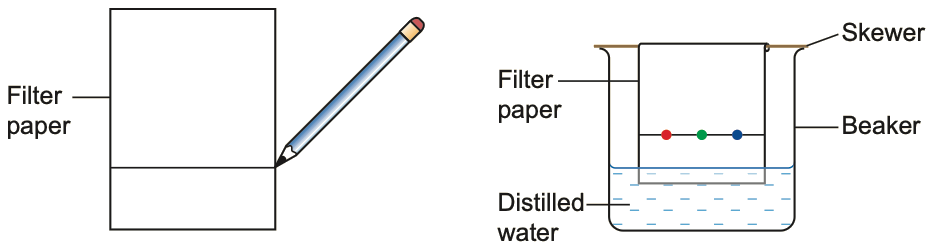
Textbook Figures 6.26 and 6.27, p. 184
Show answerHide answer
6.3Compounds
A compound is formed when two or more elements combine chemically. The new product has its own characteristics, different from the elements it came from. Everyday compounds include salt, sugar, chalk, marble, polythene (a plastic of carbon and hydrogen) and water (hydrogen and oxygen). Rust is a compound formed when iron reacts with oxygen.
How metals and non-metals form compounds
sodium + water → sodium hydroxide + hydrogen gas (alkali metals: lithium, sodium, potassium)
iron + sulphur → iron sulphide (when heated)
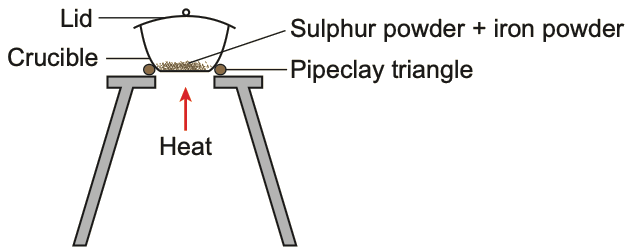
Textbook Figure 6.28, p. 186
Almost all mineral salts in nature exist as compounds, except for gold, silver and platinum, which are found as pure elements.
Separating a compound: electrolysis
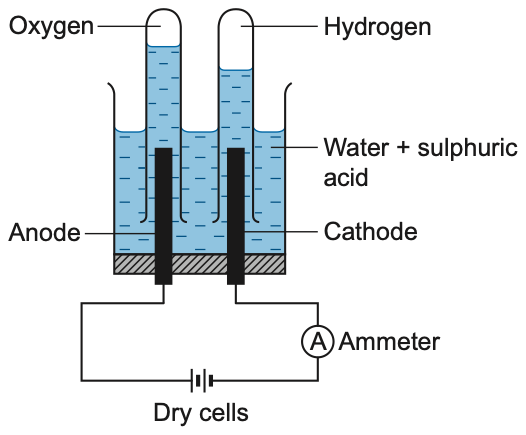
Textbook Figure 6.29, p. 187
- Hydrogen gas collects at the negative electrode (cathode).
- Oxygen gas collects at the positive electrode (anode).
- Water is broken down into its two elements, so water is a compound.
Physical change and chemical change
| Physical change | Chemical change | |
|---|---|---|
| New substance? | No new substance formed | A new substance is formed |
| Properties | Stay the same | Products have different properties |
| Chemical composition | Stays the same | Changes |
| Energy | Needs less energy | Needs more energy |
| Examples | Ice melting, water freezing, water boiling | Rusting of iron, photosynthesis, decaying leaves, cell respiration |
Based on textbook Figures 6.30 and 6.31, p. 188
Mixtures and compounds compared
| Characteristic | Mixture | Compound |
|---|---|---|
| New substance formed? | No | Yes |
| Chemical bond? | No | Yes |
| Separation method | Physical | Chemical (electrolysis) |
| Properties compared with the original substances | Same | Different |
Textbook Table 6.2, p. 189
Show answerHide answer
Summary
| Remember | Key fact |
|---|---|
| Subatomic particles | Proton (+) and neutron (0) in the nucleus; electron (−) around it. "PEN" |
| Atom is neutral | Number of protons = number of electrons |
| Molecule | Two or more atoms joined together |
| Element vs compound | One type of atom vs two or more elements combined chemically |
| Periodic Table | Arranged by proton number; metals left, non-metals right, inert gases in Group 18 |
| Metals | Shiny, ductile, malleable, good conductors, high melting point (carbon is the non-metal that conducts) |
| Mixture | Combined physically → separated physically (filtration, distillation, magnet, sedimentation, floatation, chromatography) |
| Compound | Combined chemically → separated chemically (electrolysis) |
| Chemical change | Forms a new substance; mass is conserved |