Science questions, chapter 6
Periodic Table
44 marks. Use Practice to check each answer as you go, or Exam to answer everything against the clock first.
Section A: objective questions
12 marksChoose the best answer for each question.
1
Which subatomic particle has a negative charge?
Show answerHide answer
A
The electron is negative, the proton is positive and the neutron has no charge. The nucleus is not a subatomic particle — it is the centre of the atom that holds the protons and neutrons.
2
Why is an atom neutral?
Show answerHide answer
A
The positive charges of the protons are cancelled by the same number of negative electrons. Neutrons have no charge, so their number does not matter, and the nucleus itself is positive.
3
Which of the following is a compound?
Show answerHide answer
C
Water is made of two elements, hydrogen and oxygen, combined chemically, so it is a compound. Oxygen and copper are elements (one type of atom each). Air is a mixture of gases that are not combined chemically.
4
The elements in the Periodic Table are arranged according to their
Show answerHide answer
B
The Periodic Table arranges elements in order of proton number.
5
Neon is an inert gas. Which element is in the same group (column) of the Periodic Table as neon?
Show answerHide answer
D
The inert gases (helium, neon, argon, krypton, xenon, radon) are all in the last column, Group 18. Sodium and iron are metals; oxygen is a non-metal in Group 16.
6
Which characteristic belongs to a non-metal?
Show answerHide answer
C
Non-metals are brittle (they break easily). Shiny, malleable and a high melting point are characteristics of metals.
7
Element E is black, smooth and light. It is a non-metal but it can conduct electricity. It is used to make pencil lead. What is E?
Show answerHide answer
B
Carbon is the only non-metal that conducts electricity, and pencil lead is made of carbon. Copper conducts but is a metal; sulphur and iodine do not conduct.
8
Some iron nails fell into a box of sand. What is the best method to separate the nails from the sand?
Show answerHide answer
D
Iron is magnetic and sand is not, so a magnet pulls out the nails. Distillation and filtration need a liquid; chromatography is for dissolved dyes.
9
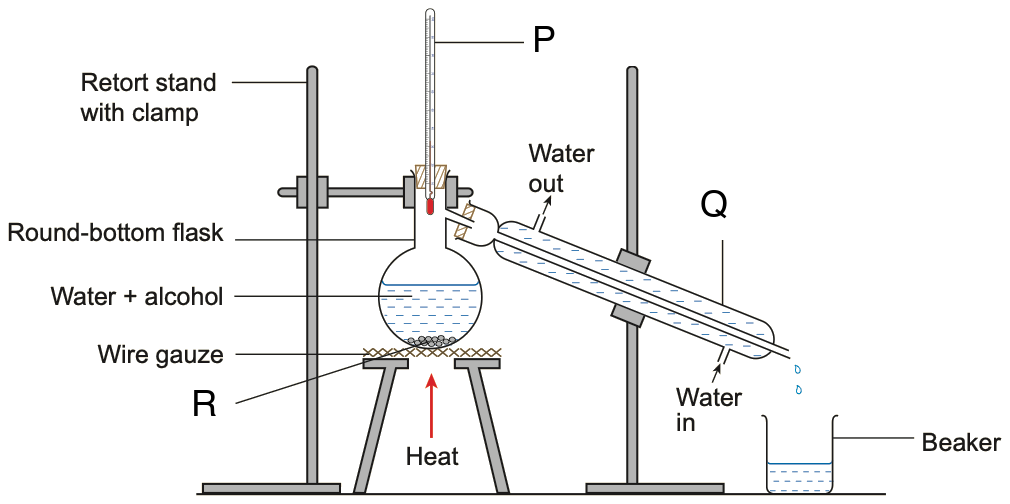
Diagram 1 shows the apparatus used to separate a mixture of water and alcohol. What is the function of R?
Show answerHide answer
A
R is the porcelain chips. They make the boiling smooth. The condenser (Q) cools the vapour and the thermometer (P) measures the boiling point.
10
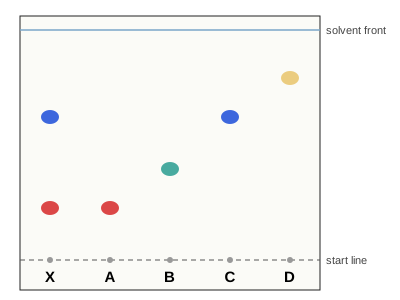
Diagram 2 shows the result of chromatography on ink X and four dyes, A, B, C and D. Which dyes are present in ink X?
Show answerHide answer
B
Ink X separates into two spots. The lower spot is at the same height as the spot of dye A and the upper spot is at the same height as the spot of dye C, so X contains A and C. B and D have spots at heights that X does not have.
11
Which of the following is a chemical change?
Show answerHide answer
C
Rusting forms a new substance (rust, iron oxide), so it is a chemical change. Melting, boiling and freezing only change the state; no new substance is formed.
12
Which method is used to separate a compound into its elements?
Show answerHide answer
D
The elements in a compound are bonded chemically, so it can only be separated chemically, by electrolysis. The other three are physical methods for mixtures.
Section B: structured questions
32 marksAnswer all questions. Write your answers in the spaces provided.
13
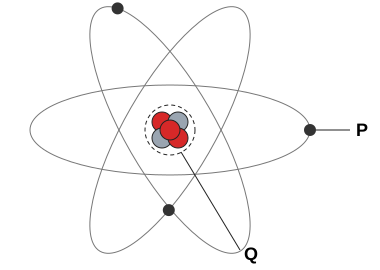
Diagram 3 shows a model of an atom.
[1 mark]
(a)Name particle P.
Show answerHide answer
Electron
Electrons move around the outside of the nucleus.
[1 mark]
(b)Name part Q.
Show answerHide answer
- Nucleus1
Tick each point you got.
[2 marks]
(c)Name the two types of particle found in Q.
Show answerHide answer
- Proton [1]1
- Neutron [1]1
Tick each point you got.
14
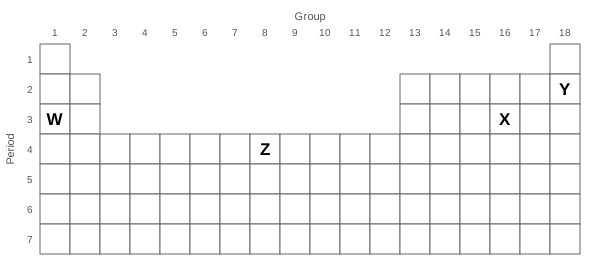
Diagram 4 shows an outline of the Periodic Table. W, X, Y and Z are four elements. (The letters are not the real symbols of the elements.)
[1 mark]
(a)Element W is a
Show answerHide answer
Metal
W is on the far left of the table (it is sodium).
[1 mark]
(b)Element X is a
Show answerHide answer
Non-metal
X is on the right side but not in the last column (it is sulphur).
[1 mark]
(c)Element Y is a
Show answerHide answer
Inert gas
Y is in the last column, Group 18 (it is neon).
[2 marks]
(d)State two differences in physical characteristics between W and X.
Show answerHide answer
Any 2 points
- W is shiny; X is dull1
- W is malleable / ductile; X is brittle1
- W conducts electricity well; X conducts poorly1
- W conducts heat well; X conducts heat poorly1
- W has a high melting / boiling point; X has a low melting / boiling point1
- W has high density / tensile strength; X has low density / tensile strength1
Tick each point you got.
15
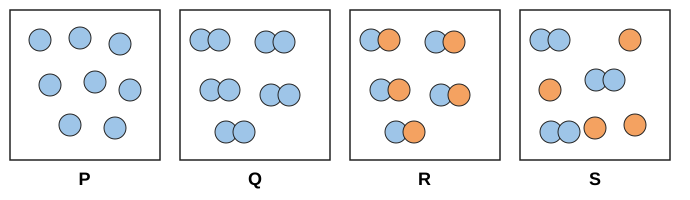
Diagram 5 shows the particles in four substances, P, Q, R and S. Each circle colour represents a different type of atom.
[1 mark]
(a)Which two substances are elements?
Show answerHide answer
- P and Q (both needed)1
Each contains only one type of atom.
Tick each point you got.
[1 mark]
(b)Which substance is a mixture?
Show answerHide answer
S
S contains two different substances that are not joined together.
[1 mark]
(c)Explain why R is a compound and not a mixture.
Show answerHide answer
- Each particle of R contains two different (types of) atoms joined / combined chemically1
Tick each point you got.
16
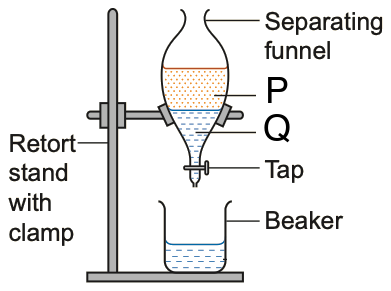
Diagram 6 shows a mixture of oil and water in a separating funnel.
[1 mark]
(a)Layer P is
Show answerHide answer
Oil
[1 mark]
(b)Explain why P is above Q.
Show answerHide answer
- Oil is less dense than water, so it floats on water1
Tick each point you got.
[1 mark]
(c)Name this method of separation.
Show answerHide answer
- Floatation method1
Tick each point you got.
[1 mark]
(d)Describe how you would collect the water in a beaker without the oil.
Show answerHide answer
- Open the tap to let the water (bottom layer) run into the beaker, then close the tap just before the oil reaches it1
Tick each point you got.
17
Kumutha is given a mixture of sand, iron filings and salt. She wants to obtain each substance separately.
[2 marks]
(a)State the method she should use first to remove the iron filings. Give a reason.
Show answerHide answer
- Using a magnet [1]1
- Iron is a magnetic substance; sand and salt are not [1]1
Tick each point you got.
[1 mark]
(b)She then adds water and stirs. Which substance dissolves?
Show answerHide answer
Salt
[1 mark]
(c)Name the method she should use next to remove the sand from the salt solution.
Show answerHide answer
- Filtration (sand is the residue)1
Tick each point you got.
[1 mark]
(d)How can she obtain salt from the salt solution?
Show answerHide answer
- Heat / evaporate the salt solution so that the water evaporates and the salt is left behind1
Tick each point you got.
18
Some students were filtering a mixture of sand and salt solution. The filtering took a long time, so they decided to stir the mixture on the filter paper with a glass rod.
[2 marks]
(a)Is stirring the mixture on the filter paper a good idea? Give your reasons.
Show answerHide answer
Any 2 points
- No, it is not a good idea [1]1
- The glass rod can tear the filter paper [1]1
- Sand would then pass into the filtrate, so the mixture is not separated [1]1
Tick each point you got.
[1 mark]
(b)Suggest a better way to make the separation faster.
Show answerHide answer
Any 1 points
- Let the sand settle first, then pour off the clear solution slowly (sedimentation) before filtering1
- Use a bigger filter funnel / more filter funnels and pour the mixture in small portions1
Tick each point you got.
19
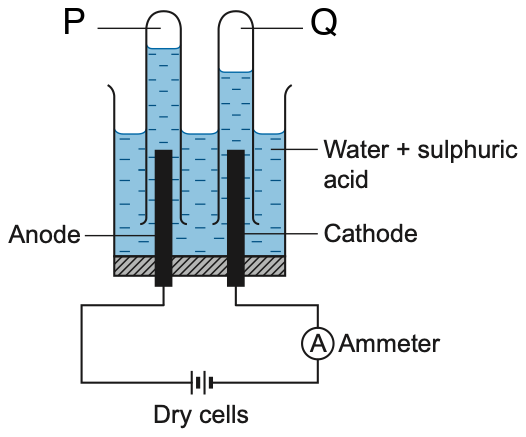
Diagram 7 shows the apparatus used to break down water.
[1 mark]
(a)Gas P is
Show answerHide answer
Oxygen
Oxygen is collected at the positive electrode (anode).
[1 mark]
(b)Gas Q is
Show answerHide answer
Hydrogen
Hydrogen is collected at the negative electrode (cathode).
[1 mark]
(c)Name this process.
Show answerHide answer
- Electrolysis1
Tick each point you got.
[1 mark]
(d)Is water an element or a compound? Explain your answer.
Show answerHide answer
- Compound — it can be broken down (chemically, by electrolysis) into two elements, hydrogen and oxygen1
Tick each point you got.
20
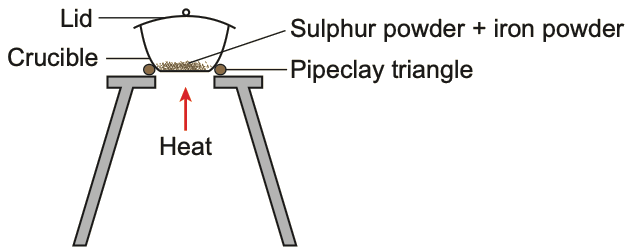
Aiman heats a mixture of iron powder and sulphur powder in a crucible with a lid. He weighs the crucible, lid and contents before and after heating.
| Mass (g) | |
|---|---|
| Before heating | 52.4 |
| After heating | 52.4 |
[1 mark]
(a)Write the word equation for the reaction.
Show answerHide answer
- iron + sulphur → iron sulphide1
Tick each point you got.
[1 mark]
(b)What can Aiman conclude from his results?
Show answerHide answer
- Mass is conserved in a chemical change (the total mass before and after heating is the same)1
Tick each point you got.
[2 marks]
(c)Aiman's friend says the product is still a mixture of iron and sulphur. Plan a simple test, using one piece of apparatus, to show that a new compound has formed. State what you would do and what you would observe.
Show answerHide answer
- Hold a magnet near the mixture before heating and near the product after heating [1]1
- Before heating the iron powder is attracted to the magnet; after heating the product (iron sulphide) is not attracted, so a new substance / compound has formed [1]1
Tick each point you got.