Coordination and Response
By the end of this chapter you can
- Explain the meaning of homeostasis (3.1)
- Describe how the human body regulates water content and body temperature, and how animals respond to temperature changes (3.1)
- Explain how plants regulate water content through transpiration and the stoma (3.1)
- Explain why homeostasis is important to humans and other living things (3.1)
3.1Homeostasis in Living Things
When the inside of the body stays balanced, all the living processes in the body work well. If the internal conditions are not balanced, for example the temperature becomes too high, the cells of the organism may die.
Our normal body temperature is about 37 °C. Other animals have their own normal temperature: a magpie is about 39 °C and a porcupine about 31 °C. If body temperature moves more than about 6 °C away from normal, a person can die. That is why a patient with a high fever must be watched closely.
The homeostatic control process
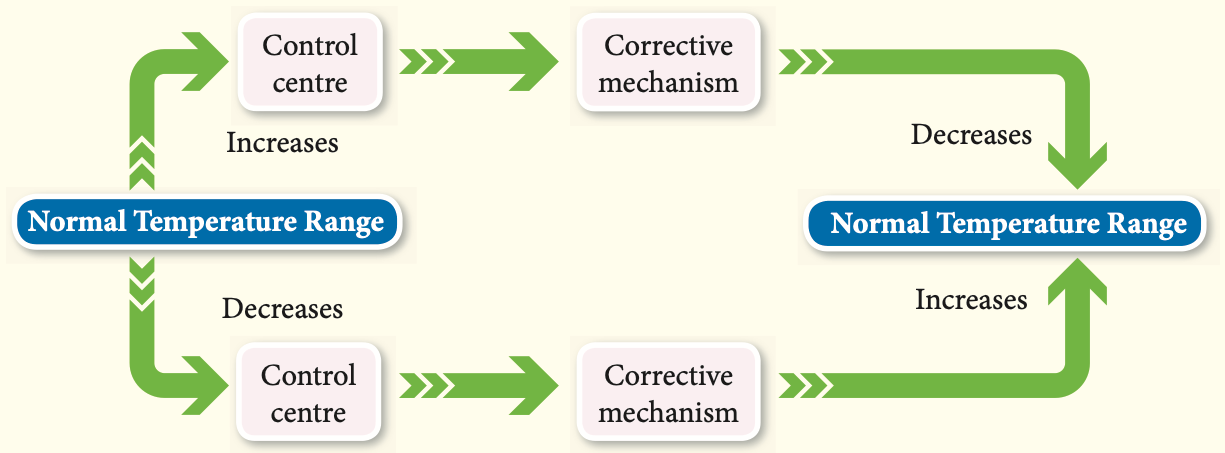
- A condition inside the body (for example temperature) increases or decreases away from its normal range.
- The control centre in the brain detects the change.
- A corrective mechanism takes place.
- The condition returns to its normal range.
The two most important kinds of homeostasis in humans are the regulation of water content and the regulation of body temperature.
Regulation of water content
Systems involved: the excretory system and the endocrine system (the hormone system). Organs involved: the kidneys and the brain.
| Water content too high | Water content too low | |
|---|---|---|
| Cause | We drink a lot of water | We sweat a lot (hot day, exercise) |
| Detected by | The brain | The brain |
| Corrective mechanism | The brain stimulates the secretion of a hormone so that the kidneys increase urine production. More urine is produced. | The brain stimulates the secretion of a hormone so that the kidneys decrease urine production. Less urine; we feel thirsty. |
| Result | Water content decreases to the normal level | Water content increases to the normal level |
Based on textbook Figure 3.2, p. 74.
Show answerHide answer
Regulation of body temperature
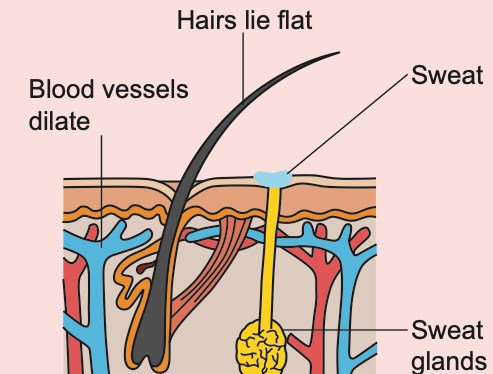
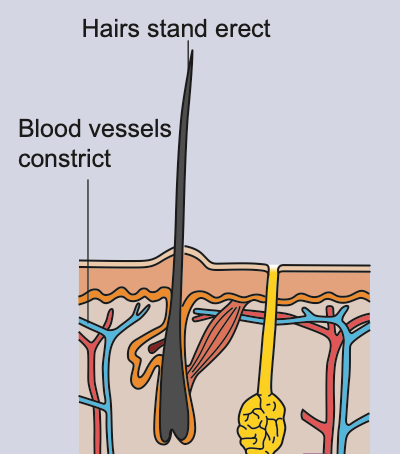
Systems involved: the excretory system and the endocrine system. Organs involved: the skin, the brain and the skeletal muscles. The normal body temperature is 37 °C.
| Hot day (body temperature rises) | Cold day (body temperature falls) | |
|---|---|---|
| Blood vessels in the skin | Dilate (widen) — more blood flows close to the skin, so more heat is lost | Constrict (narrow) — blood flows away from the skin, so less heat is lost |
| Hairs | Lie flat — little air is trapped, so heat escapes easily | Stand erect — a layer of air is trapped and acts as a heat insulator |
| Sweating | Increases — sweat evaporates and cools the skin | Decreases — less heat lost by evaporation |
| Skeletal muscles and hormones | Muscle activity and certain hormones reduce | Muscles contract and relax actively, so we shiver; hormones increase metabolism to make heat |
| Urine | Less urine (water is lost as sweat) | — |
Based on textbook Figure 3.3, p. 75.
Experiments on biological responses
Manipulated variable: surrounding temperature (fans off = hot, fans on = cool). Responding variable: presence of sweat. Fixed variable: time taken (10 minutes each).
Result: we sweat when the fans are off (hot), not when they are on (cool). The hypothesis is accepted.
Manipulated variable: type of activity (at rest, walking, jogging for 5 minutes). Responding variable: pulse count. Fixed variable: time taken.
Count the pulse for one minute with two fingers on the wrist. The pulse is lowest at rest and highest after jogging, so the hypothesis is accepted. After heavy tasks, students also sweat and breathe faster: their muscles produce heat, so sweat is produced to cool the body.
Show answerHide answer
Homeostasis in animals
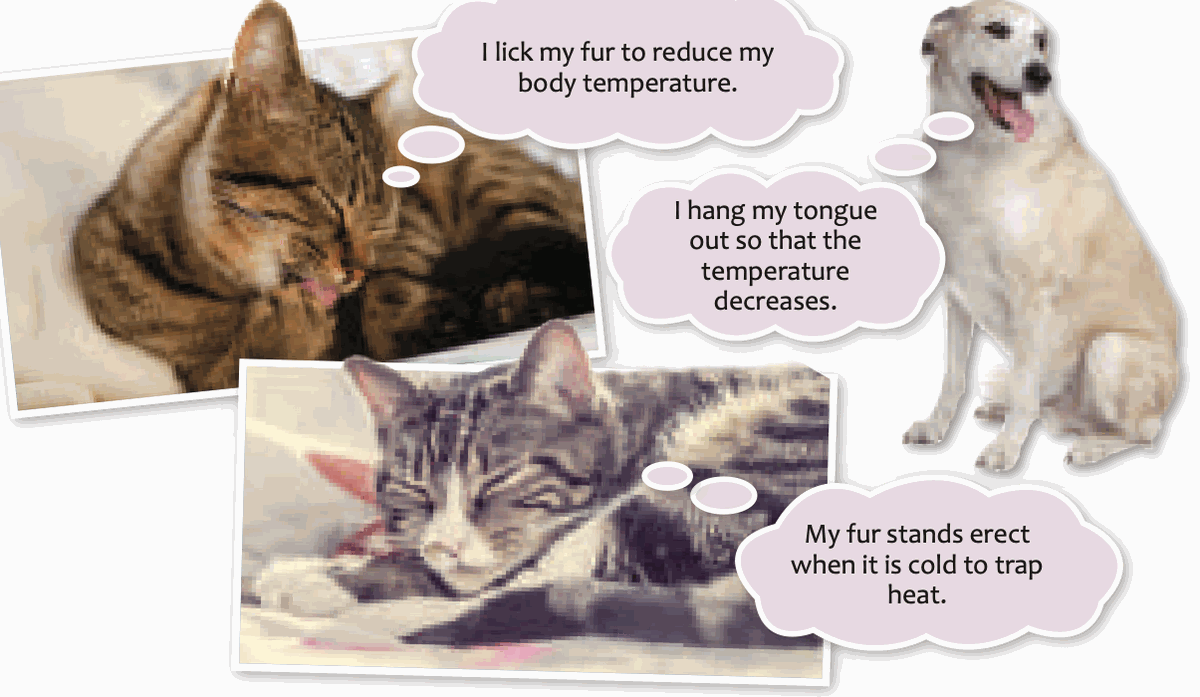
Cats and dogs have no sweat glands except on the soles of their feet, so they cool down in other ways.
| Animal | How it keeps homeostasis |
|---|---|
| Cat | Licks its fur — the saliva evaporates and lowers its body temperature. When cold, its fur stands erect to trap heat. |
| Dog | Hangs its tongue out so that water evaporates and its temperature decreases. |
| Lizard (reptile) | Cold surrounding: body activities, muscles and movements become slower; metabolism rate and body temperature decrease. Hot surrounding: heart beats faster; movements become faster; metabolism rate and body temperature increase. |
| Snail | Loses a lot of water by evaporation from its skin, so it produces fluid and looks for humid places to reduce water loss. |
| Bee | Has a waxy skin layer; it loses water vapour through its spiracles, so it closes its spiracles between breathing movements to reduce water loss. |
Based on textbook Photographs 3.4–3.7, pp. 78–79.
Homeostasis in plants
Transpiration involves the transport system of the plant. Almost 90% of the water absorbed by the roots is lost through transpiration.
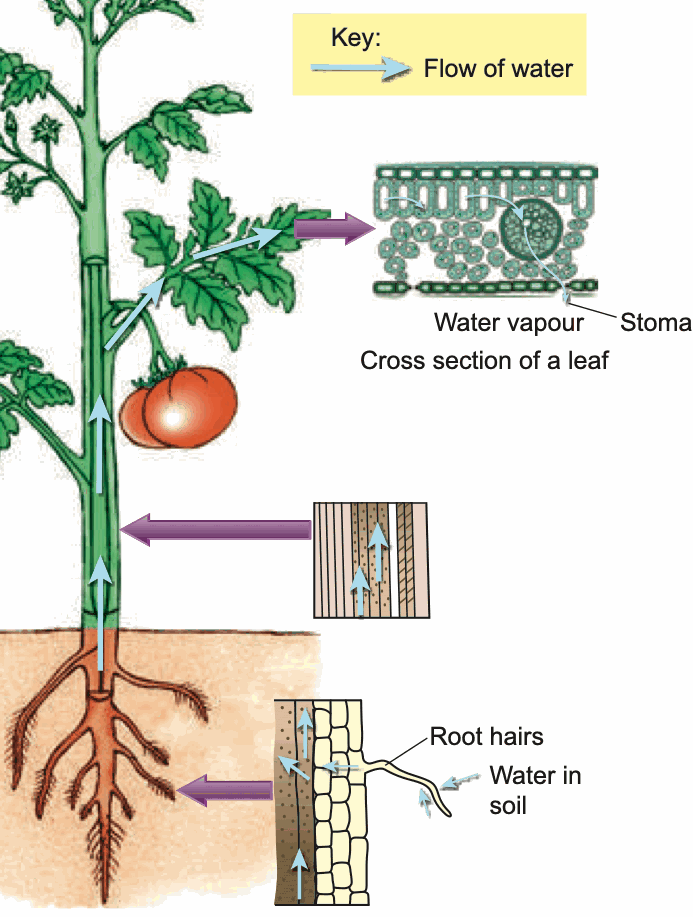
- The roots (root hairs) absorb water and minerals from the soil.
- Transpiration at the leaves produces a pulling force that draws water up the stem.
Why transpiration is useful:
- It helps the plant absorb and carry water and minerals from the soil to all parts of the plant.
- Evaporation of water from the leaves cools the plant on hot days.
The stoma
Guard cells control the opening and closing of the stoma.
| During the day | When the temperature is too high |
|---|---|
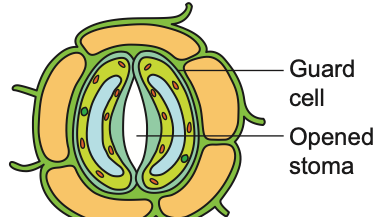 | 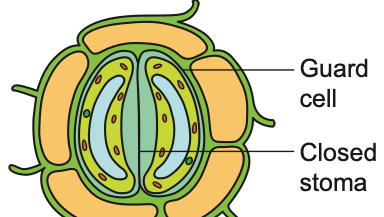 |
| The stoma opens for gas exchange. More water evaporates from the leaves, which increases the water intake by the roots. | The stoma closes to reduce the water lost through transpiration. |
Stoma drawings: textbook Figure 3.6, p. 81.
Some plants have other tricks. Banana leaves roll up in the hot afternoon to avoid losing too much water, and open again in the cooler evening (Photograph 3.8, p. 80).
Show answerHide answer
Importance of homeostasis
Homeostasis gives the optimum conditions in the body so that cells can carry out metabolism efficiently. All chemical reactions in living cells are controlled by enzymes, and enzymes are sensitive to changes such as temperature. In humans, enzymes work best at about 37 °C.
Without homeostasis, body temperature could keep rising or falling and water could be lost without control. People would become very ill, and plants would wither and die. We should be grateful that our bodies regulate themselves automatically.
Show answerHide answer
Summary
| Remember | Key fact |
|---|---|
| Homeostasis | Keeping the internal environment (temperature, water, pH, blood pressure) balanced and stable |
| Control process | Change → detected by the control centre (brain) → corrective mechanism → back to normal range |
| Water regulation | Excretory + endocrine systems; kidneys and brain. Too much water → more urine. Too little → less urine, thirsty |
| Temperature regulation | Skin, brain, skeletal muscles. Hot: vessels dilate, hairs flat, more sweat. Cold: vessels constrict, hairs erect, less sweat, shivering |
| Normal body temperature | 37 °C |
| Animals | Cat licks fur, dog hangs tongue out, lizard slows down in the cold, snail seeks humid places, bee closes spiracles |
| Plants | Transpiration through the stoma; guard cells open the stoma by day and close it when too hot |
| Why it matters | Enzymes need optimum conditions (37 °C in humans) so that cells work efficiently |