Science questions, chapter 3
Coordination and Response
44 marks. Use Practice to check each answer as you go, or Exam to answer everything against the clock first.
Section A: objective questions
12 marksChoose the best answer for each question.
1
What is homeostasis?
Show answerHide answer
A
Homeostasis is the maintenance of the internal environment (temperature, water, pH, blood pressure) in a balanced and stable condition (textbook p. 72).
2
Which of the following is not part of the internal environment controlled by homeostasis?
Show answerHide answer
C
Homeostasis controls conditions such as temperature, water content, pH and blood pressure. Height is not kept at a balanced level by homeostasis.
3
Which pair of organs is involved in regulating the water content of the body?
Show answerHide answer
B
Water regulation involves the excretory and endocrine systems; the organs involved are the kidneys and the brain.
4
Farid played football for two hours on a hot afternoon and sweated a lot. What happens in his body to correct his water content?
Show answerHide answer
D
Water content falls when we sweat. The brain stimulates a hormone so the kidneys decrease urine production, and we feel thirsty.
5
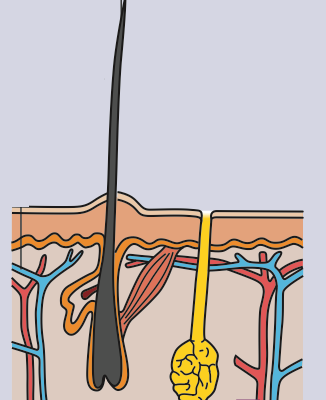
Diagram 1 shows a section through human skin. Under which condition is the skin most likely to be?
Show answerHide answer
A
The hair stands erect, which happens when it is cold. Erect hairs trap a layer of air that acts as a heat insulator. In the cold, blood vessels constrict, not dilate.
6
What is the normal human body temperature?
Show answerHide answer
B
Normal human body temperature is 37 °C. 31 °C is a porcupine and 39 °C is a magpie.
7
How does sweating help to lower body temperature?
Show answerHide answer
D
Sweat glands produce more sweat on hot days; when the sweat evaporates it cools the skin.
8
On a hot day, a dog lies in the shade with its tongue hanging out. Why does the dog do this?
Show answerHide answer
C
Dogs have sweat glands only on their soles, so they hang their tongues out so that their temperature decreases.
9
A lizard is placed in a cold surrounding. Which change happens to the lizard?
Show answerHide answer
A
In a cold surrounding a lizard's body activities, muscles and movements become slower, and its metabolism rate and body temperature decrease.
10
What is the process in which plants lose water as water vapour through the stoma?
Show answerHide answer
B
Transpiration is the loss of water from the leaves, as water vapour, through the stoma.
11
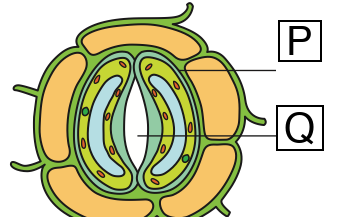
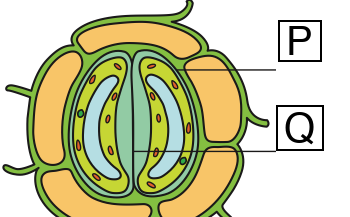
Diagram 2 shows the stoma of a leaf at two different times, X and Y. Which statement is correct?
Show answerHide answer
D
In Y the stoma is closed. Guard cells (P) close the stoma (Q) when the temperature is too high, to reduce the water lost through transpiration. X (open) is the normal daytime state for gas exchange.
12
Why is it important for the body to keep its temperature at about 37 °C?
Show answerHide answer
C
All chemical reactions in cells are controlled by enzymes, which are sensitive to temperature. A constant 37 °C lets them work at their best.
Section B: structured questions
32 marksAnswer all questions. Write your answers in the spaces provided.
13
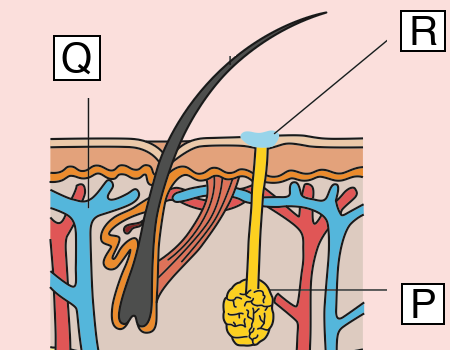
Diagram 3 shows a section of human skin on a hot day.
[1 mark]
(a)Name structure P.
Show answerHide answer
Sweat gland
P is the coiled sweat gland at the bottom of the sweat duct.
[1 mark]
(b)Name structure Q.
Show answerHide answer
Blood vessel
[1 mark]
(c)Name substance R, which comes out onto the skin surface.
Show answerHide answer
Sweat
[1 mark]
(d)Explain how Q helps the body to lose heat on a hot day.
Show answerHide answer
- Blood vessels dilate so more blood flows close to the skin, so more heat is lost to the surroundings1
Tick each point you got.
14
Mei Ling walks out of an air-conditioned room into a very cold, windy night. Her body temperature starts to fall below the normal range.
[1 mark]
(a)Which part of her body detects the fall in body temperature?
Show answerHide answer
- The brain / the control centre in the brain1
Tick each point you got.
[2 marks]
(b)State two corrective mechanisms that take place in her skin.
Show answerHide answer
Any 2 points
- Blood vessels constrict (less blood flows near the skin, so less heat is lost)1
- Hairs stand erect (trap a layer of air as an insulator)1
- Less sweating1
Tick each point you got.
[1 mark]
(c)Mei Ling starts to shiver. What causes the shivering?
Show answerHide answer
Skeletal muscles contract and relax actively
Shivering is the skeletal muscles contracting and relaxing actively to produce heat.
15
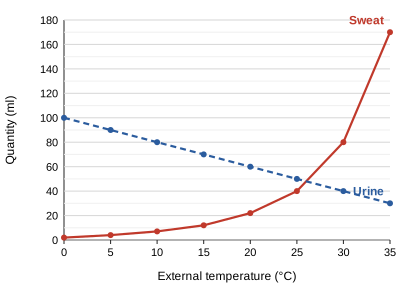
Diagram 4 shows how the quantity of sweat and urine produced by a person changes with the external temperature.
[1 mark]
(a)What is the quantity of sweat produced at 35 °C?
Show answerHide answer
- 170 ml1
Tick each point you got.
[1 mark]
(b)Describe what happens to the quantity of urine as the external temperature increases.
Show answerHide answer
- The quantity of urine decreases (from 100 ml at 0 °C to 30 ml at 35 °C)1
Tick each point you got.
[2 marks]
(c)Explain the relationship between the quantity of sweat and the quantity of urine.
Show answerHide answer
- At higher temperature more sweat is produced to cool the body, so more water is lost through the skin1
- To keep the water content balanced, the kidneys produce less urine (the brain stimulates a hormone to decrease urine production)1
Tick each point you got.
16
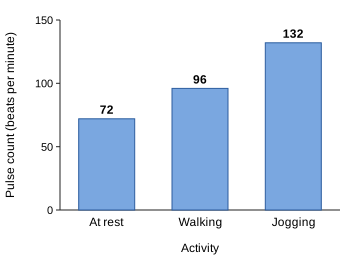
A group carried out Experiment 3.2. One student from the group did each activity for 5 minutes and then counted the pulse for one minute. Diagram 5 shows the results.
[1 mark]
(a)State the manipulated variable.
Show answerHide answer
- Type of activity1
Tick each point you got.
[1 mark]
(b)Calculate the increase in pulse count from at rest to jogging.
Show answerHide answer
- 132 − 72 = 60 beats per minute1
Tick each point you got.
[1 mark]
(c)Is the hypothesis "pulse count will increase when executing heavy tasks" accepted? Give a reason.
Show answerHide answer
- Accepted — the pulse count is highest after jogging (the heaviest task) and lowest at rest1
Tick each point you got.
[1 mark]
(d)The student was sweating after jogging. Explain why.
Show answerHide answer
- Jogging produces heat that raises body temperature, so sweat is produced to cool the body (by evaporation)1
Tick each point you got.
17
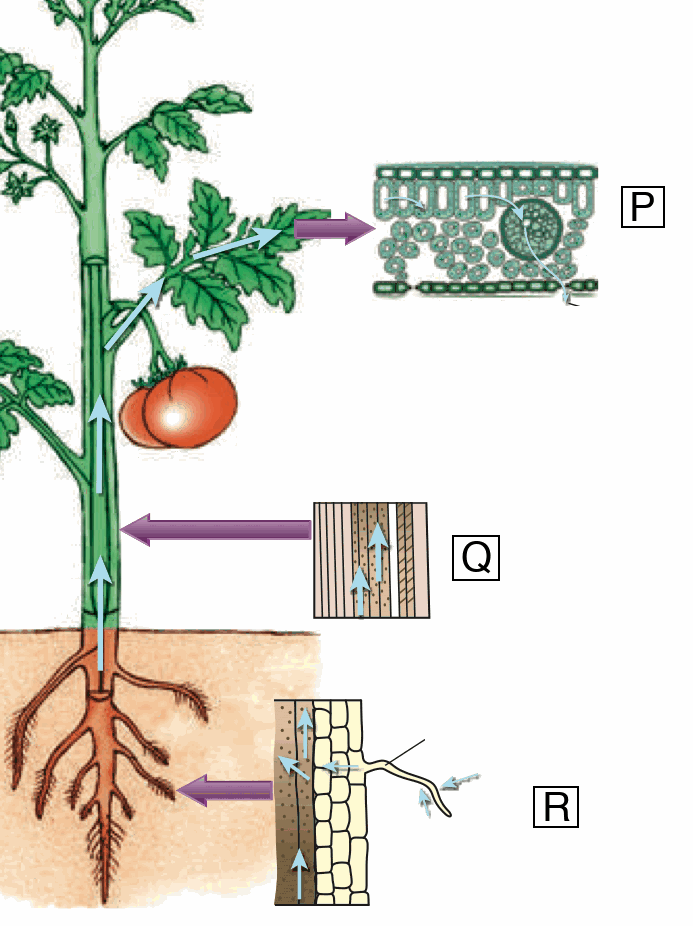
Diagram 6 shows how water moves through a plant. P, Q and R are sections through different parts of the plant.
[1 mark]
(a)Through which part does water vapour leave the plant?
Show answerHide answer
P
P is a section of the leaf. Water vapour leaves the leaf through the stoma (transpiration).
[1 mark]
(b)State the function of the root hairs shown at R.
Show answerHide answer
- Absorb water and minerals from the soil1
Tick each point you got.
[1 mark]
(c)Explain how transpiration at P helps water to move up through Q.
Show answerHide answer
- Transpiration (loss of water vapour from the leaves) produces a pulling force that draws water up the stem1
Tick each point you got.
[1 mark]
(d)State one other way transpiration helps the plant on a hot day.
Show answerHide answer
- Evaporation of water from the leaves cools the plant1
Tick each point you got.
18
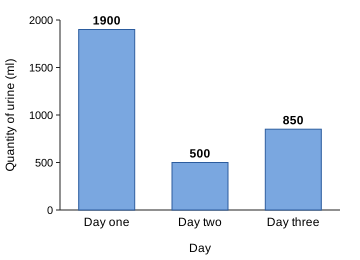
Khairul was given the same quantity of food and drinks each day for three days. His urine was collected and measured. Diagram 7 shows the results.
[1 mark]
(a)Why must the quantity of food and drinks be the same on all three days?
Show answerHide answer
- It is a constant (fixed) variable, so that the only cause of the change in urine is his activity / it is a fair test1
Tick each point you got.
[2 marks]
(b)Khairul's friend says he did the most vigorous activity on day one because he produced the most urine. Do you agree? Justify your answer.
Show answerHide answer
- Disagree — the most vigorous activity was on day two1
- Day two had the least urine (500 ml) because he lost a lot of water as sweat during vigorous activity, so the kidneys produced less urine1
Tick each point you got.
[1 mark]
(c)Khairul wants to keep warm on a cold night. Is it better to wear a few layers of thin clothing or one layer of thick clothing? Give a reason.
Show answerHide answer
- A few thin layers — air is trapped between the layers and acts as a heat insulator1
Tick each point you got.
19
Match each animal with the way it maintains homeostasis.
[1 mark]
(a)Bee
Show answerHide answer
Closes its spiracles between breathing movements
[1 mark]
(b)Snail
Show answerHide answer
Looks for humid places
[1 mark]
(c)Cat
Show answerHide answer
Licks its fur
20
Plan an experiment to test this hypothesis: More urine is produced when we drink a lot of water compared to when we drink less water.
[2 marks]
(a)State the manipulated variable and the responding variable.
Show answerHide answer
- Manipulated: volume of water drunk1
- Responding: volume of urine produced1
Tick each point you got.
[1 mark]
(b)State one constant variable.
Show answerHide answer
Any 1 points
- Time over which urine is collected1
- Same person / same activity level1
- Same surrounding temperature1
- Same food eaten1
Tick each point you got.
[2 marks]
(c)Describe the procedure. Include how the urine is measured.
Show answerHide answer
Any 2 points
- On one day drink a small volume of water (e.g. 1 litre); on another day drink a large volume (e.g. 3 litres), keeping food and activity the same1
- Collect all the urine over the same time (e.g. 24 hours) and measure its volume with a measuring cylinder1
- Record the results in a table and compare the two volumes1
Tick each point you got.