Cell as the Basic Unit of Life
By the end of this chapter you can
- Explain that living things are made of cells; prepare slides of cheek and onion cells; state the function of each cell structure; compare animal and plant cells; describe unicellular and multicellular organisms, the types of animal and plant cells, and the order cell → tissue → organ → system → organism (2.1)
- Describe cell respiration and photosynthesis, test a leaf for starch, compare the two processes and explain how they complement each other (2.2)
2.1Cell – Structure, Function and Organisation
What is a cell?
- In 1665, Robert Hooke looked at a thin piece of cork through a simple microscope he made. He saw many small box-shaped spaces and called them cells.
- In 1674, Antonie van Leeuwenhoek used a more powerful microscope and saw tiny moving microorganisms in a drop of rain water.
A cell is like a tiny factory where thousands of chemical reactions happen. Cells carry out all of life's functions, such as growth, respiration, reproduction and excretion.
Cell division: one cell divides to become two cells, then four, and so on. This makes new cells for growth and replaces old or damaged cells.
Preparing slides of animal and plant cells
| Animal cells (Activity 2.1) | Plant cells (Activity 2.2) | |
|---|---|---|
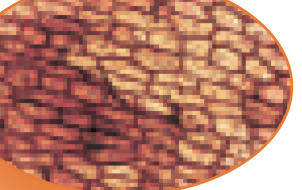
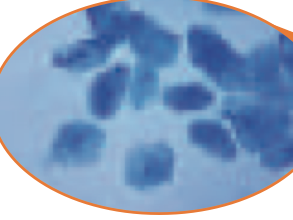
| Cells used | Cheek cells, scraped gently from inside the cheek with a toothpick | Onion epidermis, a thin layer peeled from the inside of an onion scale |
| Stain | Methylene blue solution | Iodine solution |
| Why stain? | Cells are almost colourless. A stain dyes the cell so its parts (especially the nucleus) can be seen clearly under the microscope. | |
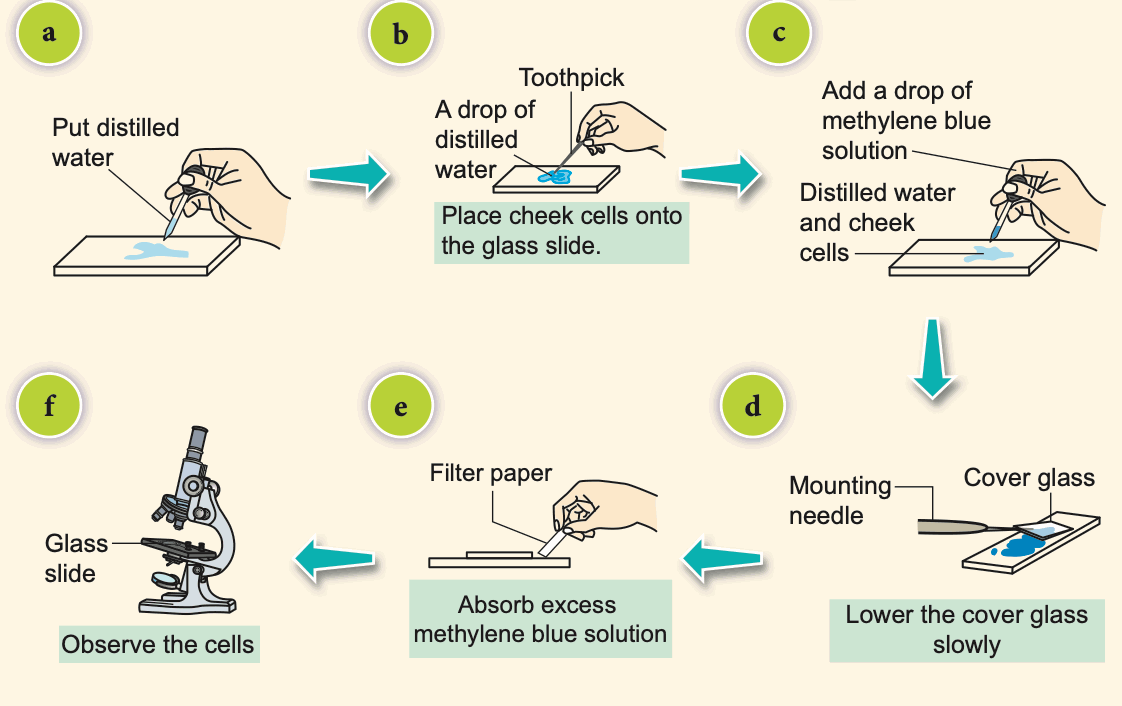
2. Place the cells (cheek cells or onion epidermis) in the water.
3. Add a drop of stain (methylene blue for cheek cells, iodine for onion cells).
4. Lower the cover glass slowly at an angle (about 45°) using a mounting needle, so that no air bubbles are trapped.
5. Use filter paper to absorb any excess stain.
6. Look at the slide under the low power objective lens first, then the high power lens. Draw and label what you see.
Structures in a cell and their functions
| Structure | Function | Found in |
|---|---|---|
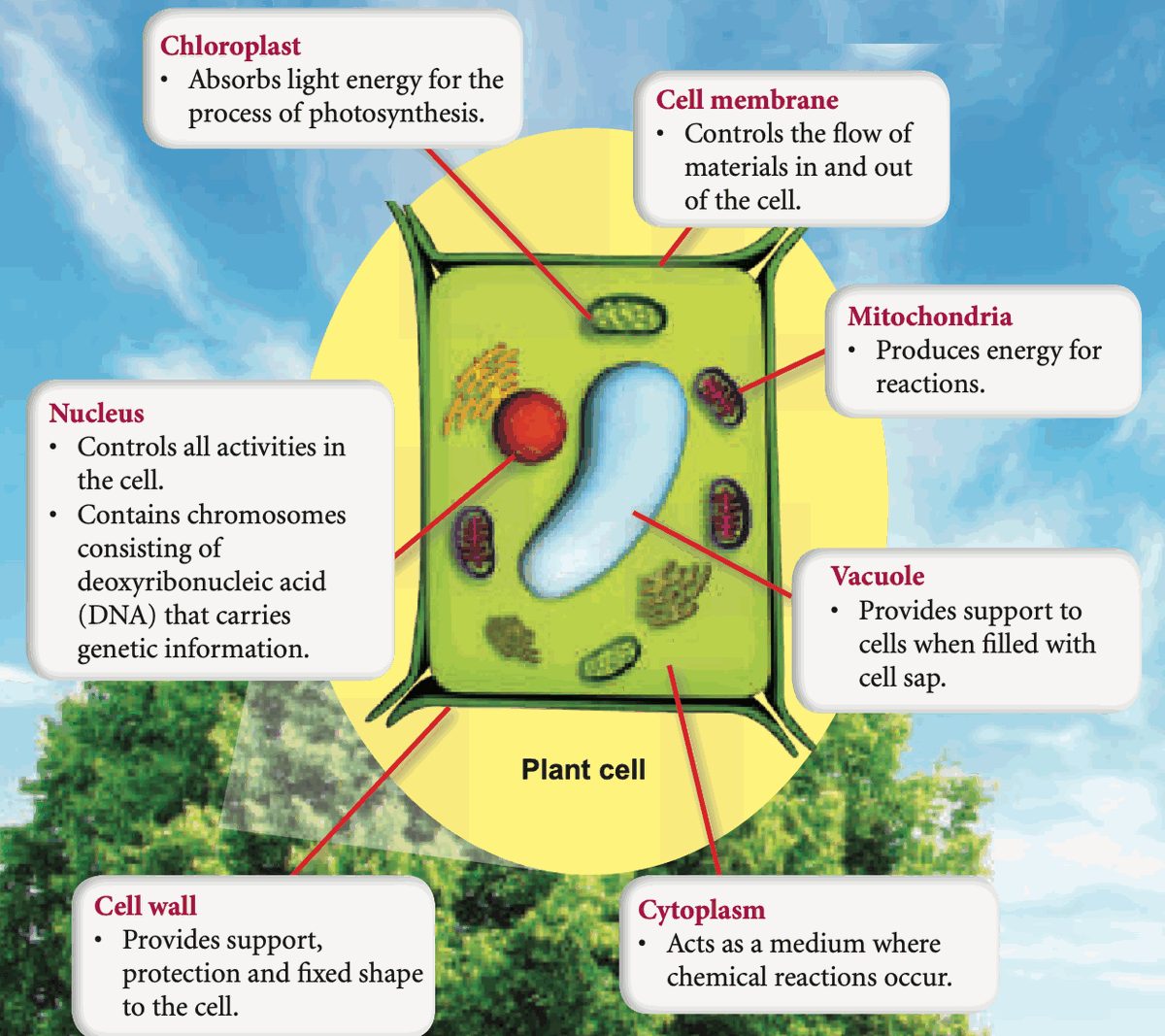
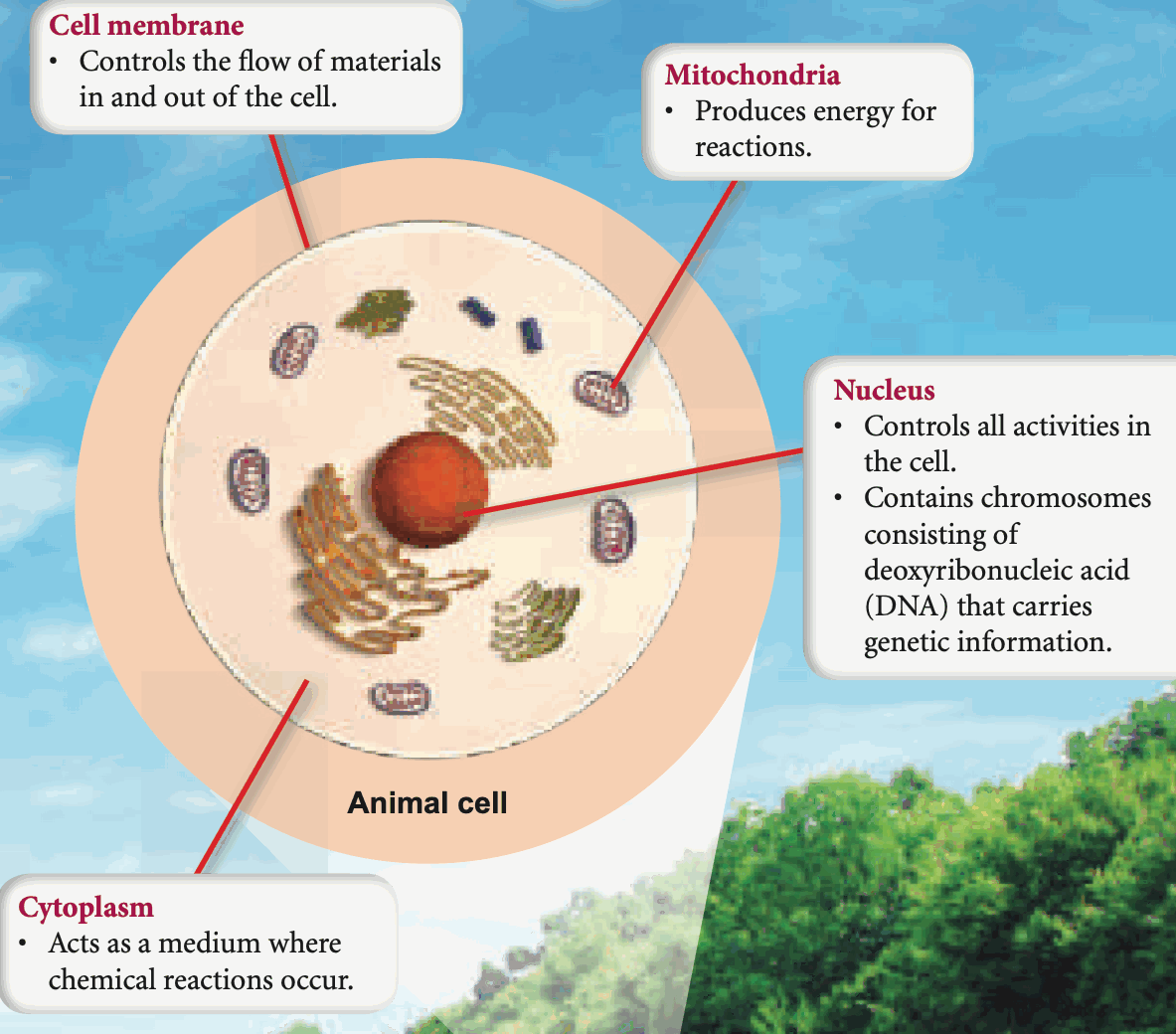
| Nucleus | Controls all activities in the cell. Contains chromosomes made of DNA (deoxyribonucleic acid), which carries genetic information. | Animal and plant cells |
| Cell membrane | Controls the flow of materials in and out of the cell. | Animal and plant cells |
| Cytoplasm | A jelly-like medium where chemical reactions occur. | Animal and plant cells |
| Mitochondria | Produce energy for the cell's reactions (cell respiration happens here). | Animal and plant cells |
| Cell wall | Gives support, protection and a fixed shape to the cell. | Plant cells only |
| Chloroplast | Contains chlorophyll that absorbs light energy for photosynthesis. | Plant cells only |
| Vacuole | Gives support to the cell when it is full of cell sap. | Plant cells (large, central) |
Comparing animal cells and plant cells
| Animal cell | Plant cell | |
|---|---|---|
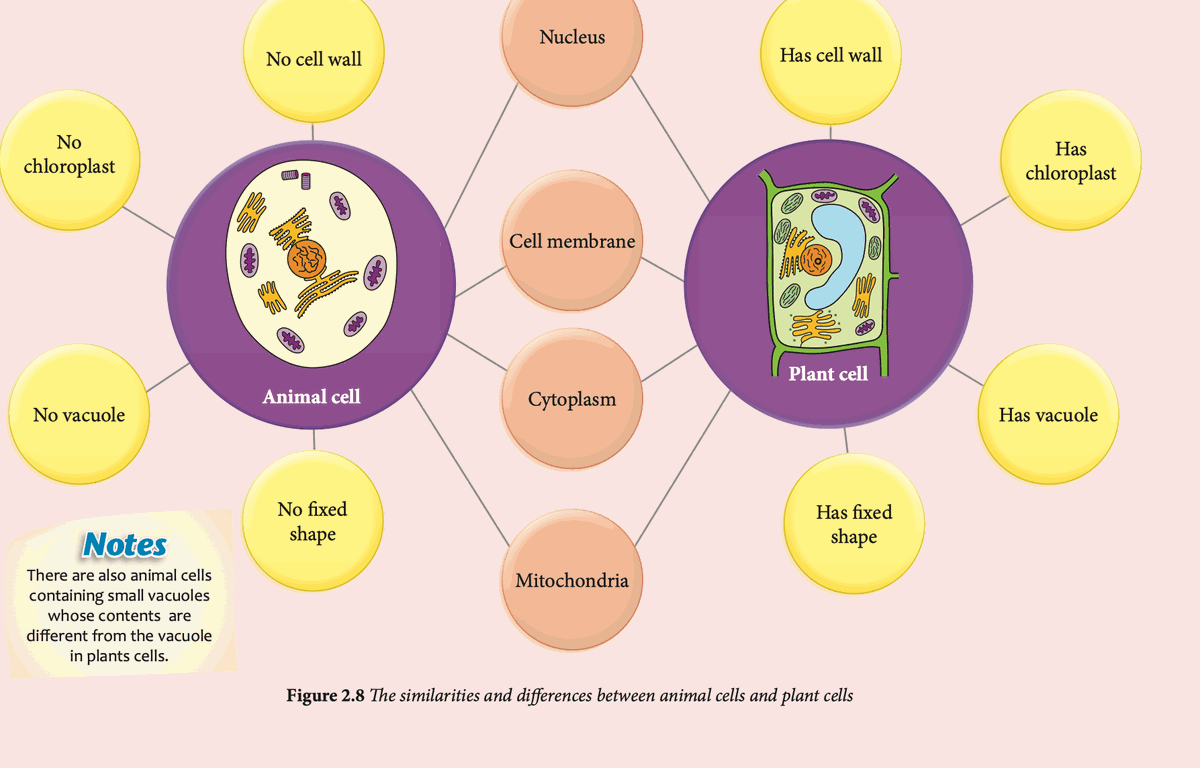
| Same in both | Nucleus, cell membrane, cytoplasm, mitochondria | |
| Cell wall | No | Yes |
| Chloroplast | No | Yes |
| Vacuole | No (some have small vacuoles) | Yes, one large vacuole |
| Shape | No fixed shape | Fixed shape |
Show answerHide answer
Unicellular and multicellular organisms
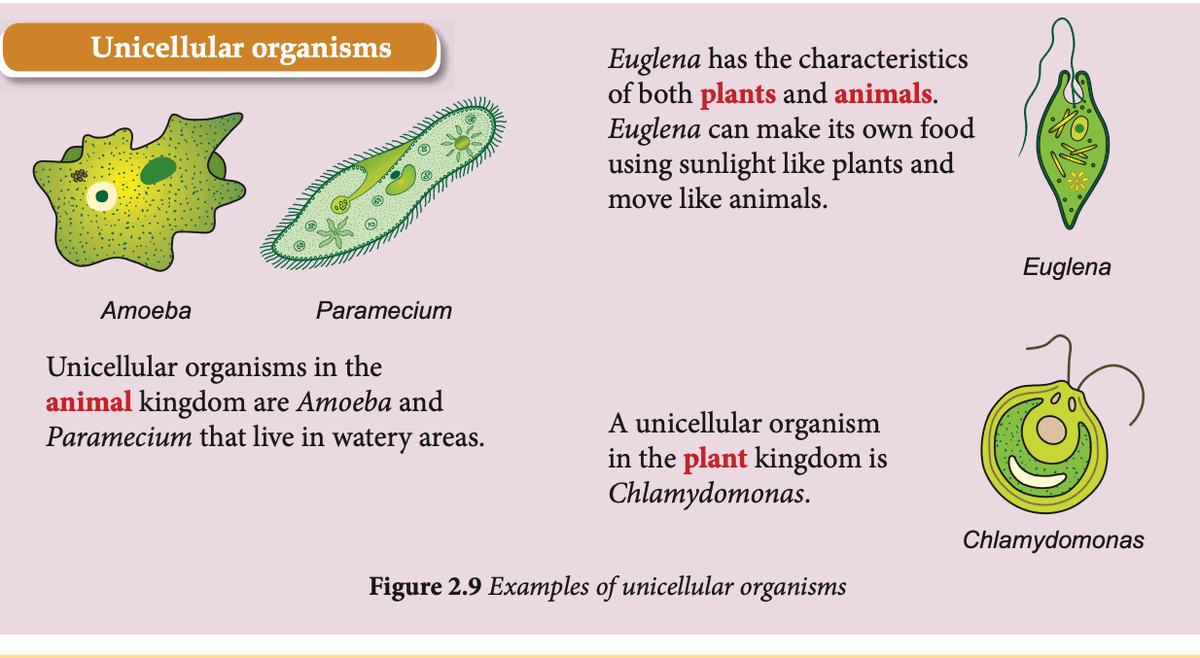
Multicellular organism ("multi" = many) — made of more than one cell.
| Unicellular | Multicellular |
|---|---|
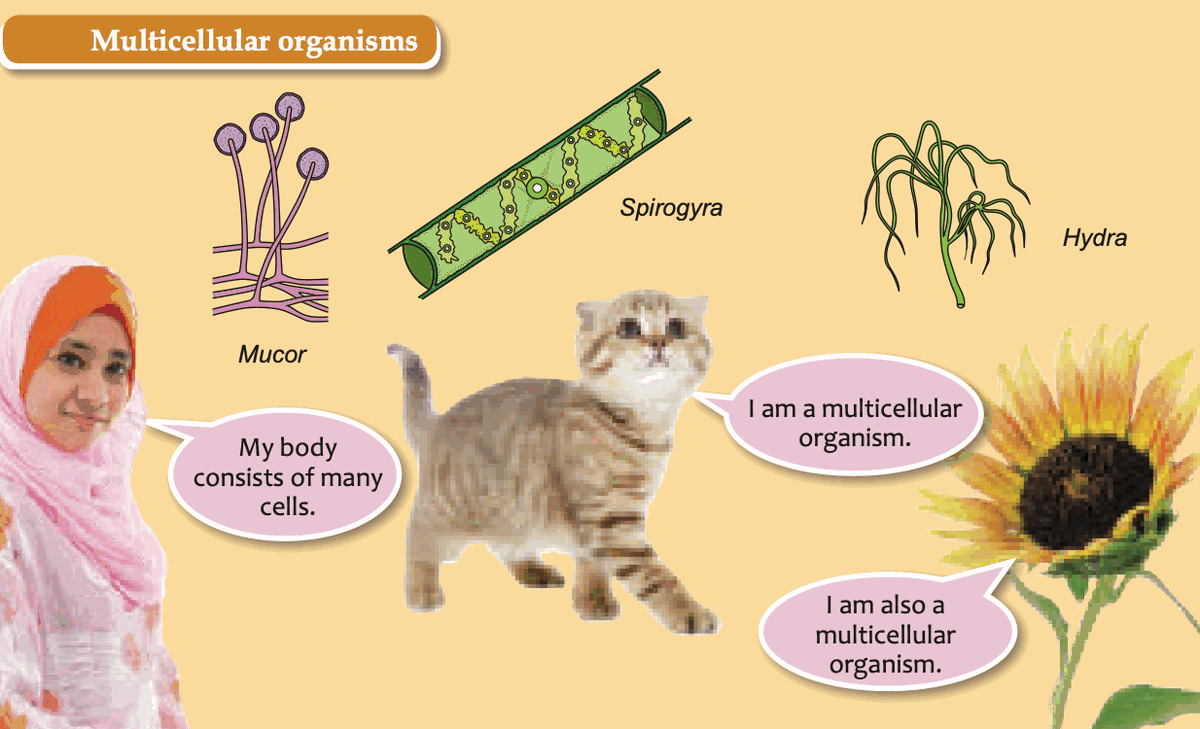
| Animal-like: Amoeba, Paramecium Plant-like: Chlamydomonas Both: Euglena (makes food with sunlight like a plant and moves like an animal) Also: yeast | Spirogyra, Hydra, Mucor, humans, cats, hibiscus, sunflowers |
Types and functions of animal cells
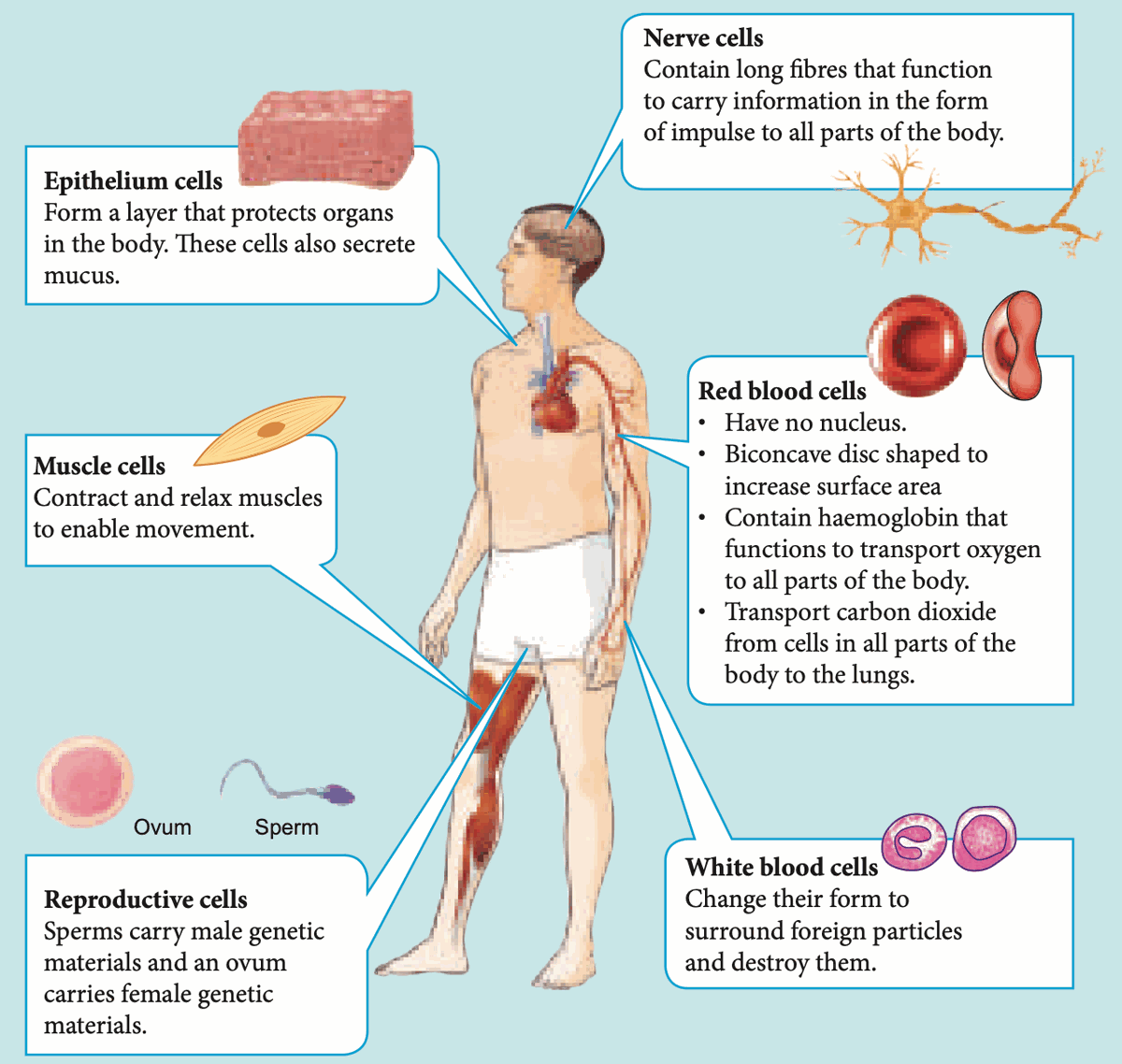
| Cell | Function / special feature |
|---|---|
| Nerve cell | Long fibres that carry information as impulses to all parts of the body |
| Epithelium cell | Forms a layer that protects organs; also secretes mucus |
| Muscle cell | Contracts and relaxes to make movement possible |
| Red blood cell | No nucleus; biconcave disc shape gives a larger surface area; contains haemoglobin to carry oxygen; also carries carbon dioxide to the lungs |
| White blood cell | Changes its shape to surround and destroy foreign particles (germs) |
| Reproductive cells | Sperm carries male genetic material; ovum carries female genetic material |
Types and functions of plant cells
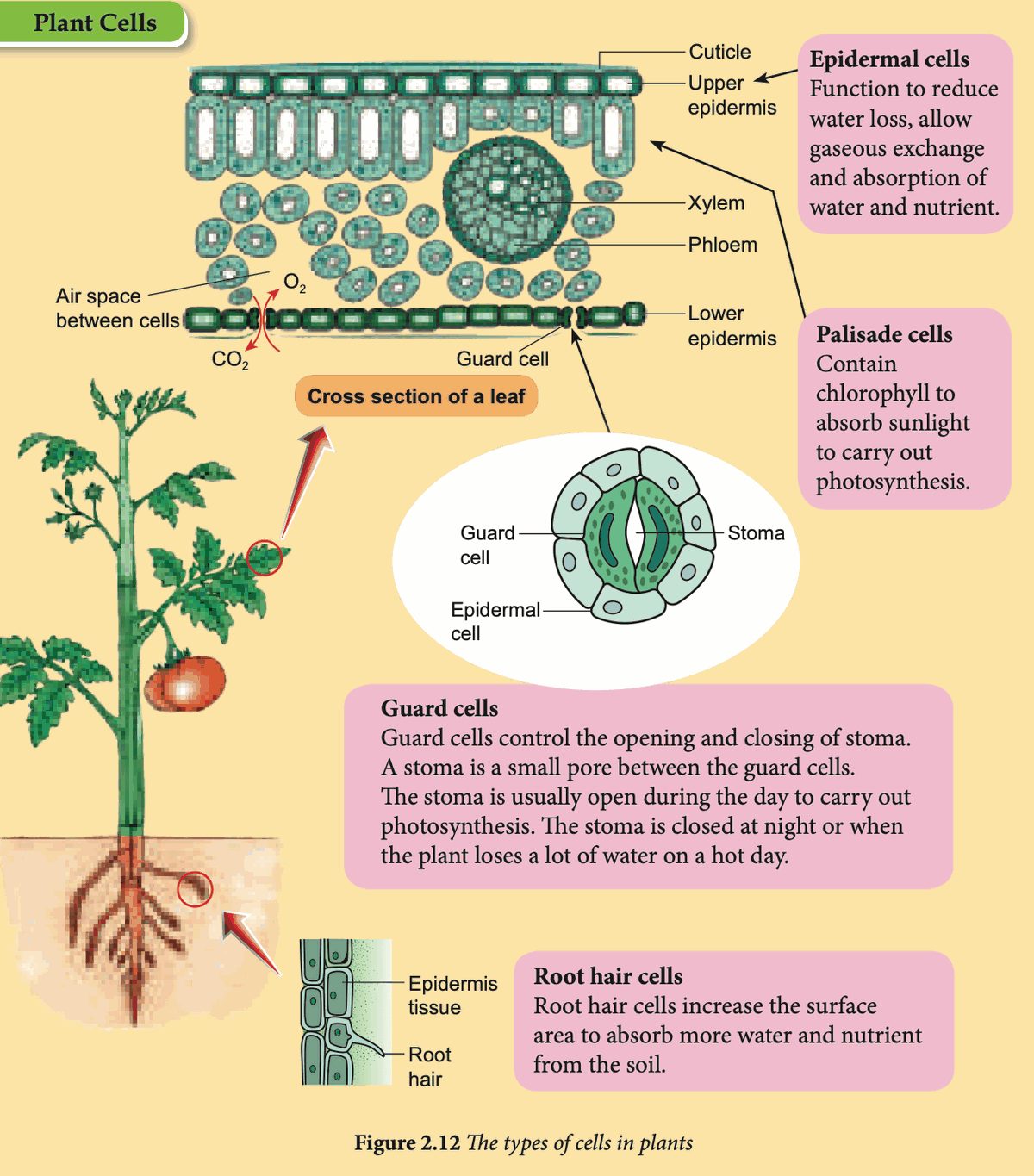
| Cell | Function |
|---|---|
| Epidermal cell | Reduces water loss; allows gas exchange and absorption of water and nutrients |
| Palisade cell | Has many chloroplasts with chlorophyll to absorb sunlight for photosynthesis |
| Guard cell | A pair of guard cells opens and closes the stoma (a small pore). Stomata are usually open in the day and closed at night or on a very hot day to save water. |
| Root hair cell | Long and thin to increase surface area to absorb more water and nutrients from the soil |
Show answerHide answer
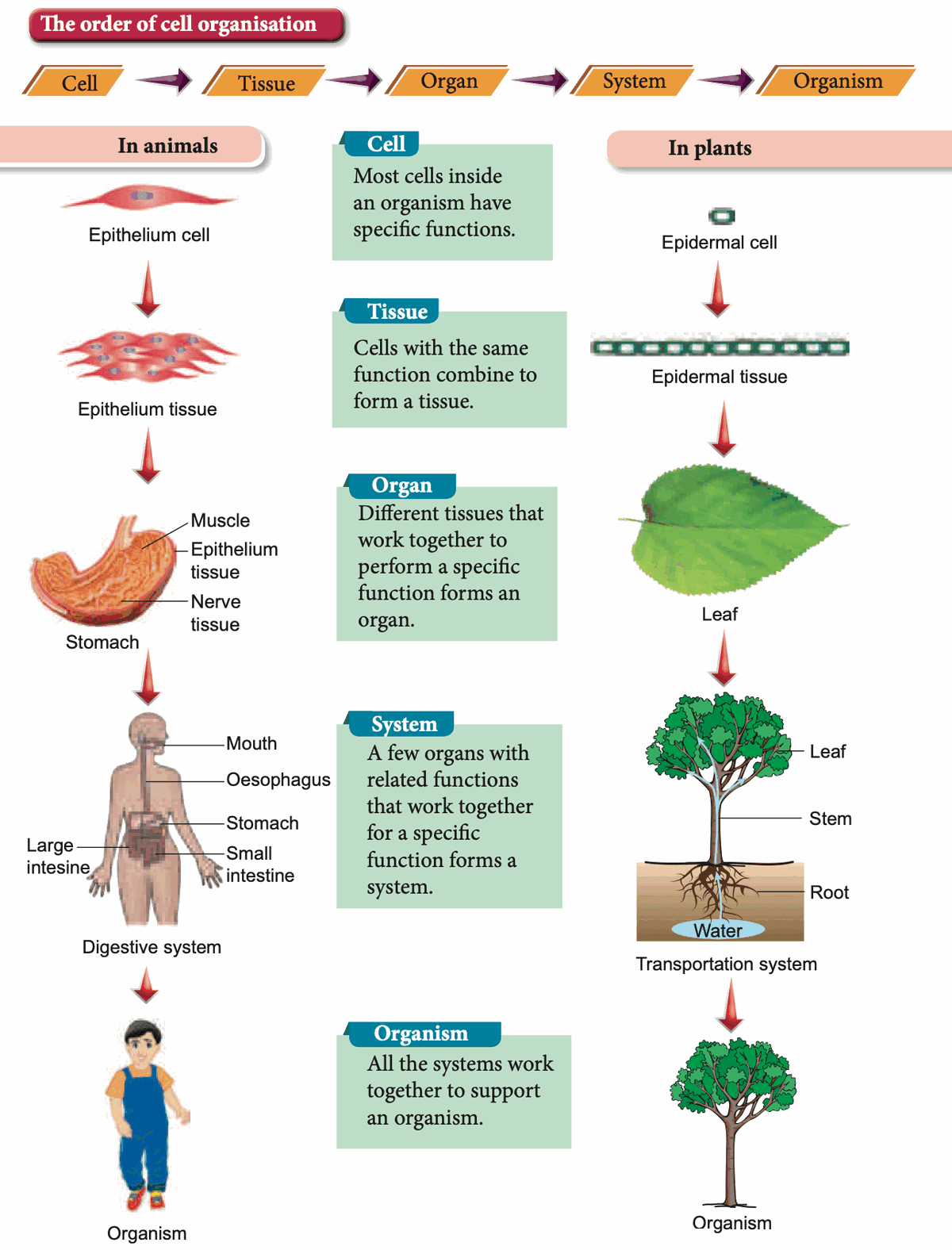
Cell organisation: from cell to organism
Tissue — a group of cells with the same function.
Organ — different tissues working together for a specific function.
System — a few organs with related functions working together.
Organism — all the systems working together to support life.
Systems in the human body
| System | Main organs | Function |
|---|---|---|
| Digestive | Mouth, oesophagus, stomach, small and large intestines | Breaks down complex food into simpler forms that the body can absorb |
| Respiratory | Nose, lungs | Takes in oxygen and gives out carbon dioxide |
| Blood circulatory | Heart, blood vessels, blood | Carries oxygen, nutrients and hormones to all parts of the body |
| Excretory | Lungs, kidneys, skin | Removes waste products from the body |
| Nervous | Brain, spinal cord, nerves | Carries information as impulses between the brain and the whole body |
| Skeletal | Bones, skull | Supports the body and protects inner organs such as the heart and lungs |
| Muscular | Muscles | Moves the body and the inner organs |
| Integumentary | Skin | Protects the body from drying out and controls body temperature |
| Lymphatic | Lymph nodes, lymph vessels | Drains lymph into the blood and protects the body from infection |
| Endocrine | Pituitary, thyroid, adrenal glands, pancreas | Produces hormones that coordinate reactions in the body |
| Reproductive | Testes, ovaries | Produces sperm and ova to make offspring |
The systems must work together (be coordinated) so the body can carry out all life processes well. We should be thankful to God for the many kinds of organisms around us.
Show answerHide answer
2.2Cell Respiration and Photosynthesis
Respiration
Respiration has two parts:
- External respiration (breathing) — exchange of gases between the organism and its surroundings.
- Internal respiration (cell respiration) — glucose is broken down (oxidised) inside living cells to release energy.
Glucose + Oxygen → Carbon dioxide + Water + Energy
The energy released is used for all life processes in the body, such as growth, movement and keeping warm.
Photosynthesis
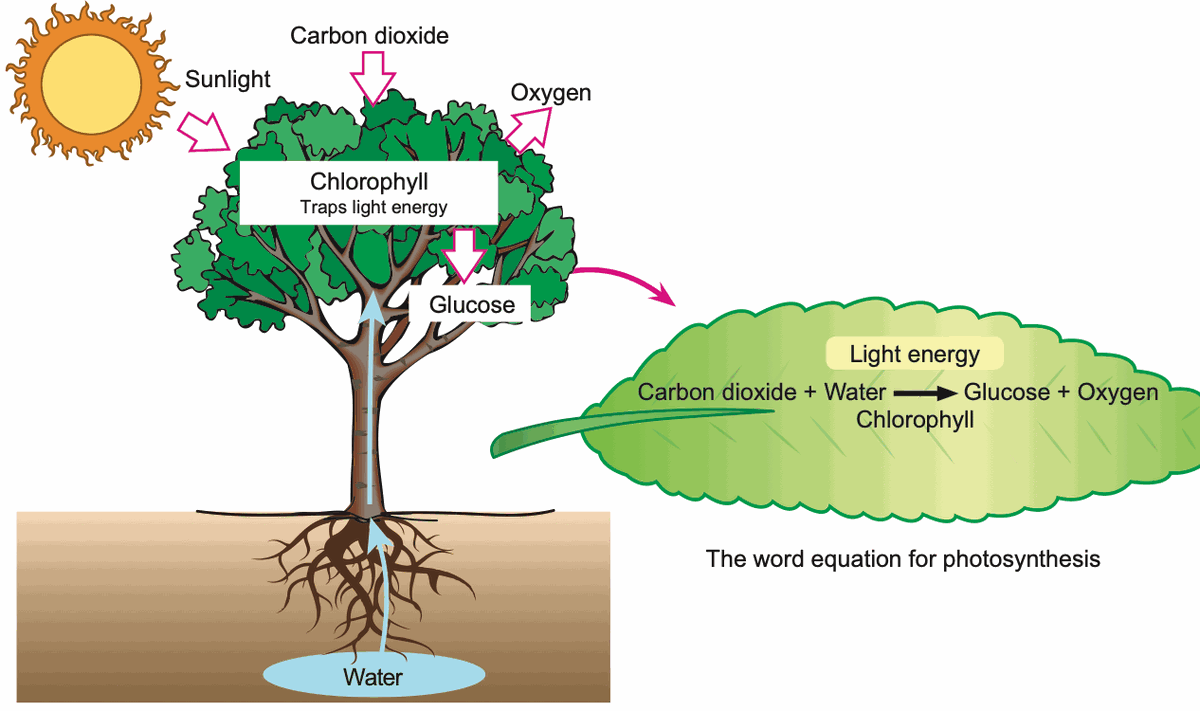
Carbon dioxide + Water —(light energy, chlorophyll)→ Glucose + Oxygen
The four needs of photosynthesis are light energy, chlorophyll, carbon dioxide and water. The glucose made is stored in the leaf as starch, so finding starch in a leaf shows that photosynthesis has happened.
Testing a leaf for starch
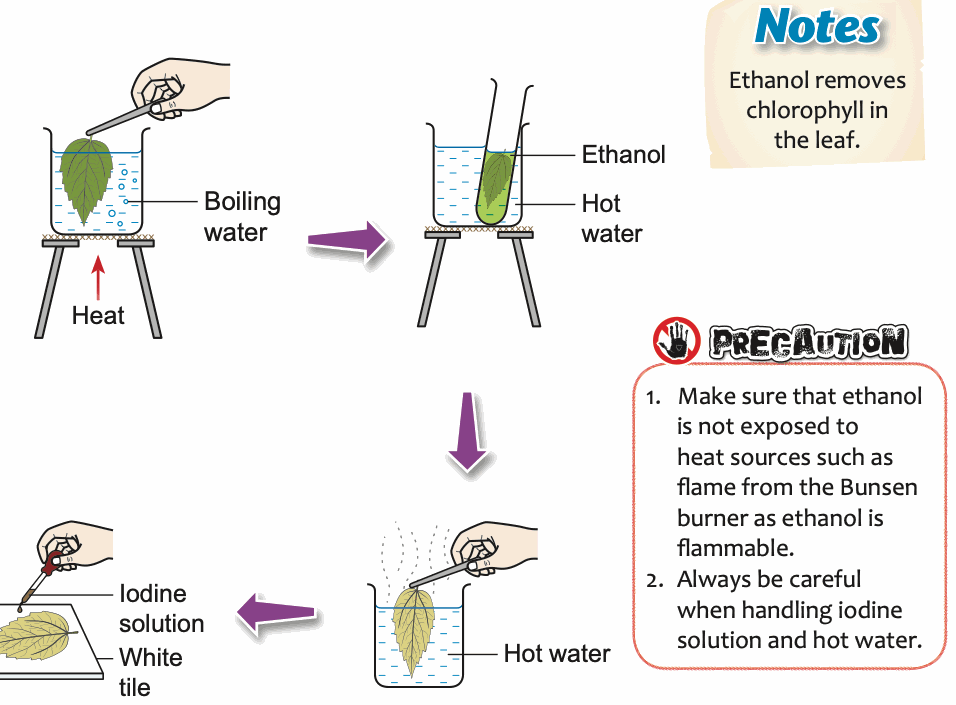
| Step | What to do | Why |
|---|---|---|
| 1 | Dip the leaf in boiling water | Breaks the cell walls and softens the leaf |
| 2 | Put the leaf in a boiling tube of ethanol, standing in a beaker of hot water (about 5 minutes) | Ethanol removes the chlorophyll so the colour change is easy to see |
| 3 | Dip the leaf in hot water for a few seconds | Softens the leaf (it becomes brittle in ethanol) |
| 4 | Spread the leaf on a white tile and add a few drops of iodine solution | Iodine turns brown → dark blue if starch is present; stays brown if there is no starch |
What does a plant need for photosynthesis? (Experiments 2.1–2.4)
In Experiments 2.1, 2.3 and 2.4, the plants are first kept in the dark for two days to remove (destarch) the starch already in the leaves. Then any starch found must have been made during the experiment. (In Experiment 2.2 the green and non-green parts of the same leaf are compared, so a variegated leaf that has been in sunlight for a few hours is used.)
| Experiment | Manipulated variable | Set-up | Result (iodine test) |
|---|---|---|---|
| 2.1 Light | Presence of sunlight | One plant in the dark, one under sunlight | Only the leaf in sunlight turns dark blue |
| 2.2 Chlorophyll | Presence of chlorophyll | A variegated leaf (green and non-green parts) kept in sunlight | Only the green part turns dark blue |
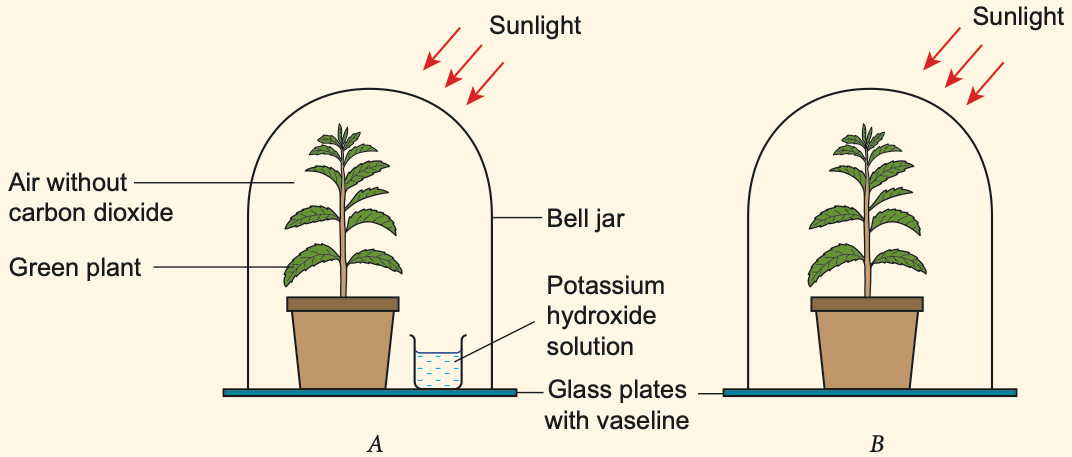
| 2.3 Carbon dioxide | Presence of carbon dioxide | Bell jar A has potassium hydroxide solution (absorbs carbon dioxide); bell jar B does not | Only the leaf from B turns dark blue |
| 2.4 Water | Presence of water | Plant A watered every day; plant B not watered | Only the leaf from A turns dark blue |
In every experiment the responding variable is the colour change of iodine solution and the constant variable is the type of plant.
Cell respiration and photosynthesis compared
| Cell respiration | Photosynthesis |
|---|---|
| Occurs in mitochondria | Occurs in chloroplasts |
| Releases energy | Absorbs (stores) energy |
| Uses chemical energy in food | Uses energy from light |
| Occurs in humans, animals, plants and microorganisms | Occurs in plants and some microorganisms |
| Breaks down glucose | Makes (synthesises) glucose |
| Uses glucose and oxygen → carbon dioxide, water and energy | Uses carbon dioxide and water → glucose and oxygen |
| Occurs at all times, day and night | Occurs only when there is light |
How the two processes complement each other
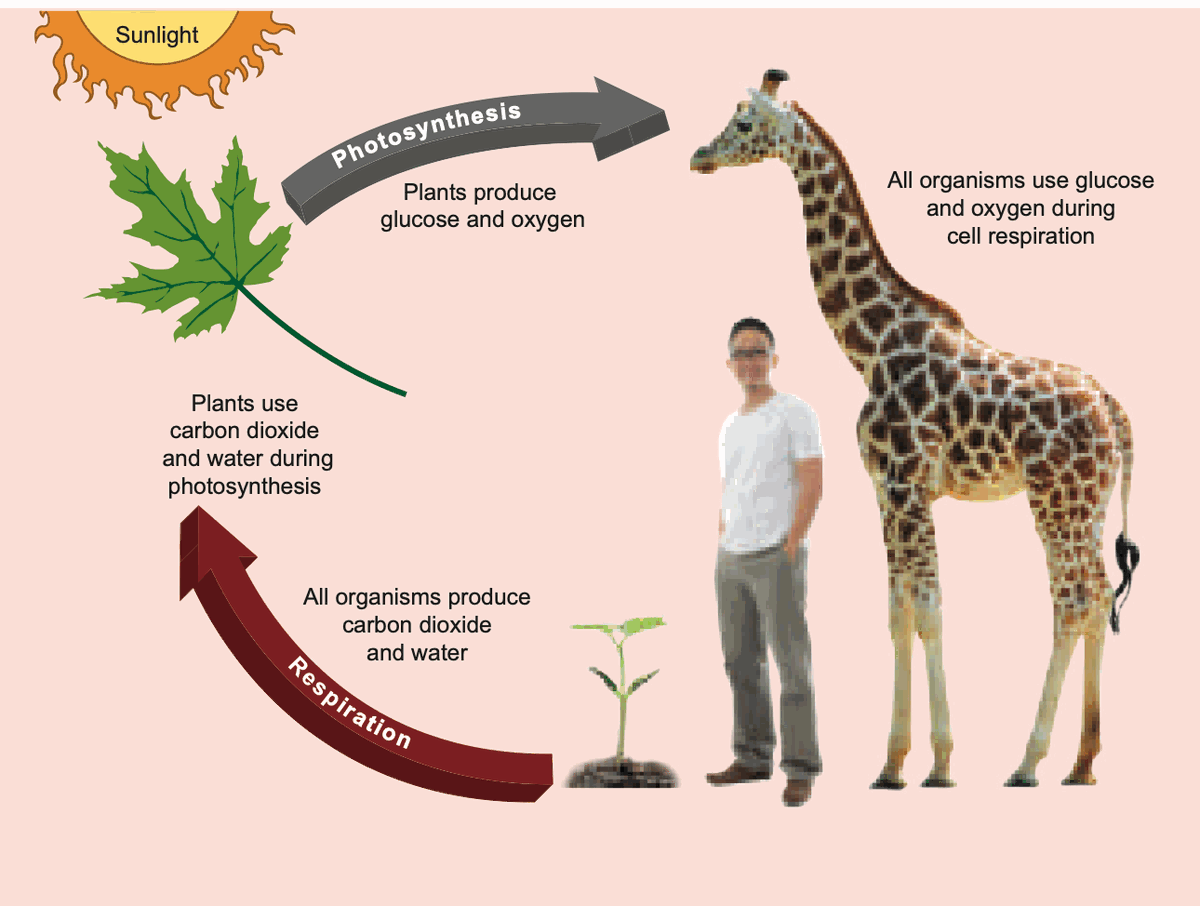
- The products of photosynthesis (glucose and oxygen) are the raw materials of cell respiration.
- The products of cell respiration (carbon dioxide and water) are the raw materials of photosynthesis.
So animals depend on plants for food and oxygen, and plants use the carbon dioxide that animals give out. This keeps the amounts of oxygen and carbon dioxide in the air balanced.
Show answerHide answer
Figures: Science Form 1 (DLP) textbook, Chapter 2, pp. 48–65.
Summary
| Remember | Key fact |
|---|---|
| Cell | The basic unit of life; first seen by Robert Hooke (1665) in cork |
| Stains | Methylene blue for cheek cells; iodine for onion cells |
| Plant cell only | Cell wall, chloroplast, large vacuole, fixed shape |
| In both cells | Nucleus, cell membrane, cytoplasm, mitochondria |
| Unicellular | One cell: Amoeba, Paramecium, Euglena, Chlamydomonas, yeast |
| Cell organisation | Cell → tissue → organ → system → organism |
| Cell respiration | Glucose + oxygen → carbon dioxide + water + energy (mitochondria, all the time) |
| Photosynthesis | Carbon dioxide + water → glucose + oxygen (needs light and chlorophyll; chloroplasts) |
| Starch test | Iodine turns brown → dark blue when starch is present |