42 marks. Use Practice to check each answer as you go, or Exam to answer everything against the clock first.
Section A: objective questions
12 marks
Choose the best answer for each question.
1
Which of the following is not matter?
Show answerHide answer
C
Matter has mass and occupies space. Light has no mass and takes up no space. Air, water (non-living) and bean sprouts (living) are all matter.
RememberingLow5.1Textbook p. 138
2
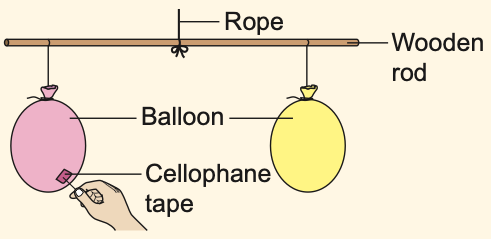
Diagram 1 shows two balanced balloons. When the balloon with cellophane tape is pricked, the rod tilts down on the side of the other balloon. What does this show?
Diagram 1
Show answerHide answer
A
When air escapes from the pricked balloon, that side becomes lighter, so the full balloon pulls its side down. The air that escaped had mass.
UnderstandingMedium5.1Textbook p. 140
3
Which of the following is a chemical property of matter?
Show answerHide answer
D
Flammability is a chemical property: when petrol burns, new substances are formed. Boiling point, solubility and melting point are physical properties.
RememberingLow5.1Textbook p. 141
4
The table shows the melting and boiling points of four substances.
Substance
Melting point (°C)
Boiling point (°C)
Water
0
100
Alcohol
−117
78
Copper
1085
2562
Oxygen
−218
−183
Which substance is a gas at room temperature (30 °C)?
Show answerHide answer
D
30 °C is above the boiling point of oxygen (−183 °C), so oxygen is a gas. 30 °C is between the melting and boiling points of water and alcohol (liquids) and below the melting point of copper (solid).
ApplyingMedium5.1Textbook p. 143
5
A piece of cork floats on a layer of oil. Why?
Show answerHide answer
B
A material with a lower density floats on a material with a higher density. Oil is denser than cork (textbook Table 5.1).
UnderstandingLow5.1Textbook p. 143
6
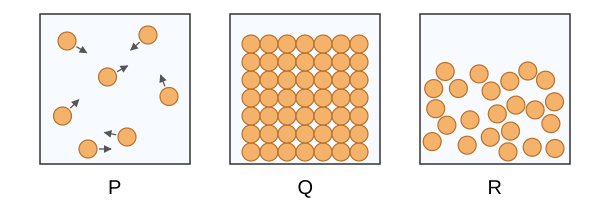
Diagram 2 shows the arrangement of particles in three substances, P, Q and R. Which substance has a fixed shape?
Diagram 2
Show answerHide answer
B
Q has particles packed very closely in an orderly pattern, so it is a solid, and only solids have a fixed shape. R is a liquid (takes the shape of its container) and P is a gas.
ApplyingMedium5.2Textbook p. 147
7
Which statement describes the kinetic theory of matter?
Show answerHide answer
C
The kinetic theory states that matter is made up of small and discrete particles that move all the time and collide with one another.
RememberingLow5.2Textbook p. 145
8
Which shows the rate of diffusion in the three states of matter, from the highest to the lowest?
Show answerHide answer
A
Gas particles are far apart and move fastest, so diffusion is fastest in a gas (bromine fills the gas jars in 15 minutes). It is slower in a liquid (about two hours) and slowest in a solid (a few days).
UnderstandingMedium5.2Textbook p. 150
9
In which process is heat released?
Show answerHide answer
C
In condensation a gas is cooled: it releases heat and its particles move slower and closer together. Melting, boiling and evaporation all absorb heat.
UnderstandingLow5.2Textbook p. 153
10
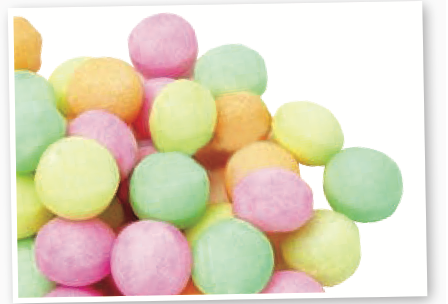
Diagram 3 shows moth balls kept in a cupboard. After a few weeks they become smaller, but no liquid is found in the cupboard. Which process has taken place?
Diagram 3
Show answerHide answer
D
The solid changes directly into a gas without becoming a liquid first. This is sublimation.
ApplyingLow5.2Textbook p. 156
11
Which statement correctly compares boiling and evaporation?
Show answerHide answer
B
Both change a liquid into a gas and both absorb heat. Evaporation happens slowly at any temperature; boiling happens only at the boiling point and is faster.
AnalysingHigh5.2Textbook p. 153
12
A beaker of ice cubes is weighed before and after the ice melts. The mass does not change. Why?
Show answerHide answer
A
Melting is a physical change. The same particles are present before and after; only their kinetic energy changes, so the mass stays constant.
UnderstandingMedium5.2Textbook p. 155
Section B: structured questions
30 marks
Answer all questions. Write your answers in the spaces provided.
13
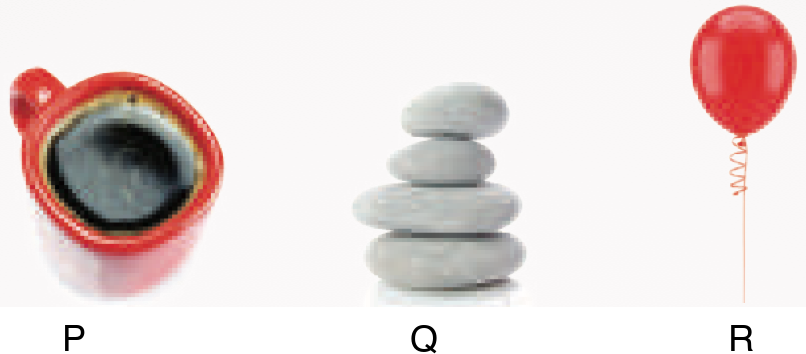
Diagram 4 shows three examples of matter: coffee (P), stones (Q) and the air inside a balloon (R).
Diagram 4
[1 mark](a)State of P (coffee)Show answerHide answer
Liquid
[1 mark](b)State of Q (stones)Show answerHide answer
Solid
[1 mark](c)State of R (air inside the balloon)Show answerHide answer
Gas
[1 mark](d)State one difference between the movement of the particles in Q and in R.
Show answerHide answer
Particles in Q (stones) only vibrate in fixed positions, while particles in R (air) move randomly and freely and collide with one another1
Tick each point you got.
RememberingLow5.2Textbook p. 159
14
State whether each of the following shows a physical property or a chemical property of matter.
[1 mark](a)Water boils at 100 °C.Show answerHide answer
Physical property
[1 mark](b)Paper burns when it is lit.Show answerHide answer
Chemical property
[1 mark](c)An iron spoon becomes hot when it is put in a cup of hot coffee.Show answerHide answer
Physical property
This is heat conductivity; no new substance is formed.
[1 mark](d)An iron key rusts when it is exposed to air and water.Show answerHide answer
Chemical property
Rust is a new substance.
UnderstandingLow5.1Textbook p. 142
15
Diagram 5 shows two examples of changes in the state of matter in daily life.
[1 mark](a)Sweet cream is put in a freezer and becomes ice cream. Name the process.Diagram 5(a)Show answerHide answer
Freezing
[1 mark](b)Water droplets form on leaves early in the morning. Name the process.Diagram 5(b)Show answerHide answer
Condensation
Water vapour in the air is cooled and condenses into water droplets (dew).
[1 mark](c)In process (b), is heat absorbed or released by the water vapour?Show answerHide answer
Released
ApplyingMedium5.2Textbook p. 156
16
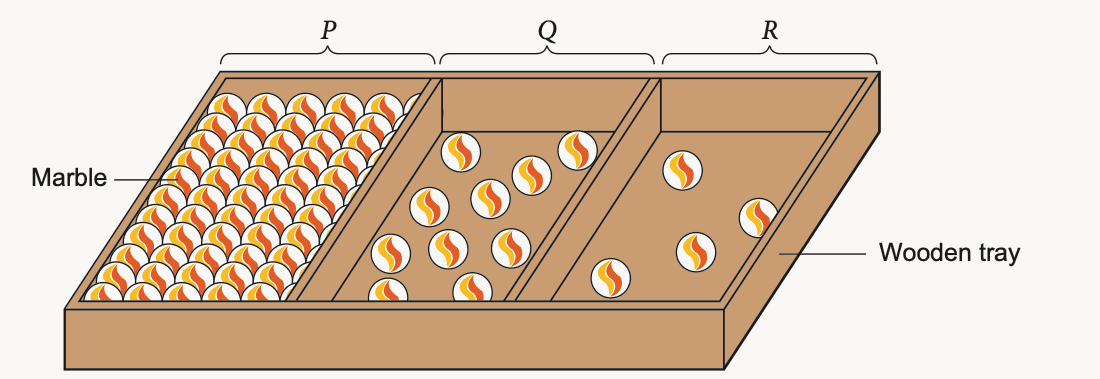
Umar puts marbles into a wooden tray with three sections, P, Q and R, as shown in Diagram 6. He uses it as a model of the three states of matter.
Diagram 6
[1 mark](a)Which section is a model of a gas?Show answerHide answer
R
R has a few marbles far apart, like gas particles.
[2 marks](b)Umar shakes the tray gently. Describe the movement of the marbles in P and explain which state of matter P represents.
Show answerHide answer
The marbles in P can only vibrate / shake in their places (they cannot move around)1
P represents a solid because its particles are packed very closely and vibrate in fixed positions1
Tick each point you got.
AnalysingMedium5.2Textbook p. 160
17
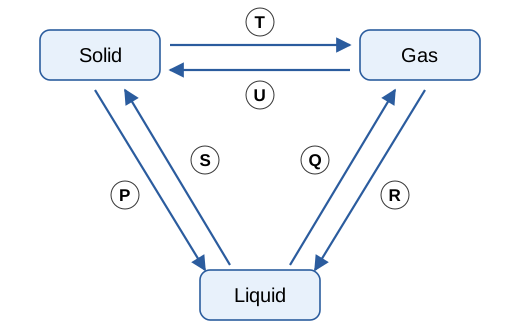
Diagram 7 shows the changes in the state of matter. P, Q, R, S, T and U are processes.
Diagram 7
[1 mark](a)Name process P.
Show answerHide answer
Melting1
Tick each point you got.
[1 mark](b)Name process R.
Show answerHide answer
Condensation1
Tick each point you got.
[1 mark](c)Name process T.
Show answerHide answer
Sublimation1
Tick each point you got.
[1 mark](d)Which processes absorb heat?
Show answerHide answer
P, Q and T (all three needed)1
Melting (P), boiling (Q) and sublimation from solid to gas (T) absorb heat. R, S and U release heat.
Tick each point you got.
ApplyingMedium5.2Textbook p. 152
18
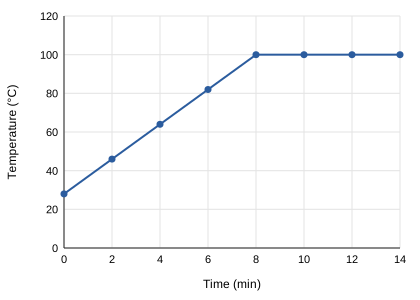
Nadia heats 100 ml of water in a beaker and records its temperature every 2 minutes. Diagram 8 shows her results.
Diagram 8
[1 mark](a)What is the boiling point of water?
Show answerHide answer
100 °C1
Tick each point you got.
[1 mark](b)At what time does the water start to boil?
Show answerHide answer
8 minutes1
Tick each point you got.
[2 marks](c)Explain why the temperature stays the same from 8 minutes to 14 minutes even though the water is still being heated.
Show answerHide answer
The heat absorbed is used to overcome / break the force of attraction between the water particles1
So the heat is not used to raise the temperature (the water is changing into gas / steam)1
Tick each point you got.
AnalysingHigh5.2Textbook p. 154
19
Tan finds that his bicycle tyre is flat, so he pumps air into it.
[1 mark](a)Describe the air particles inside the tyre after it is pumped.
Show answerHide answer
There are more air particles and they are pushed (compressed) closer to one another / they move randomly and collide with the tyre wall1
Tick each point you got.
[2 marks](b)Tan decides not to pump the tyre until it is very tight. Is his decision correct? Justify your answer.
Show answerHide answer
Yes, it is correct1
In hot weather the air particles gain (kinetic) energy, move faster and the air expands, so a very tight tyre may burst1
Tick each point you got.
[1 mark](c)Tan's tyre looks flatter on a cold morning. Explain why.
Show answerHide answer
The air releases heat, its particles lose kinetic energy, move slower and closer together, so the air contracts1
Tick each point you got.
EvaluatingHigh5.2Textbook p. 161
20
A sailor has run out of drinking water in the middle of the sea. He has only seawater, a large container, a sheet of plastic, a small stone and a drinking glass.
[3 marks](a)Using only these items, design a way for the sailor to obtain pure water from seawater. Explain how it works.
Show answerHide answer
Any 3 points
Pour seawater into the container and stand the empty glass in the middle of it (rim above the seawater)1
Cover the container with the plastic sheet and put the stone on the plastic just above the glass, so the plastic dips down over the glass1
Leave it in the sun: water evaporates, the water vapour condenses on the cooler plastic and drips into the glass1
Salt does not evaporate (its boiling point is much higher), so it stays behind in the container1
Tick each point you got.
[1 mark](b)Suggest one simple way to prove that the water collected is pure.
Show answerHide answer
Any 1 points
Evaporate / heat a few drops of the water on a clean dish — no salt (white residue) is left behind1
Taste a drop: it is not salty1
Check that it boils at 100 °C (pure water boils at 100 °C)1